
By Susan Sanei-Stamp
Canadian financial institutions invest real money and real talent in telling Canadians who they are: through purpose statements, brand platforms, and promises about what it feels like to bank with them. Those are the commitments customers will test, especially when rates are high, life is expensive, and patience is thin.
Research from our Financial Services team reveals that, at first glance, the system looks healthy. Nine in ten customers (90%) say their main financial institution (FI) lives up to the messages it puts into market, and 92% say the experience is consistent across channels. If you stop there, it can look like the brand is safe, the experience is aligned, and the machine is humming.
But this is where leaders risk being lulled into the wrong conclusion. “Net strong” is not the same as “resilient under pressure”, and the question isn’t whether you pass. The question is whether you are bankable when it counts. We pressure-tested that topline through our Promise-Experience Integrity Index. It links stated delivery to behavioural risk and client impact by looking at customers across two dimensions:
- Belief in the brand promise
- Consistency of lived brand experiences
Together, these two forces reveal four distinct outcomes:
- Credible Advantage: high belief, high consistency
- Fragile Alignment: belief that is not reinforced by strong, consistent delivery
- Narrative Risk: consistent execution that lacks emotional credibility
- Trust Erosion: breakdown on both fronts, where belief and experience are misaligned
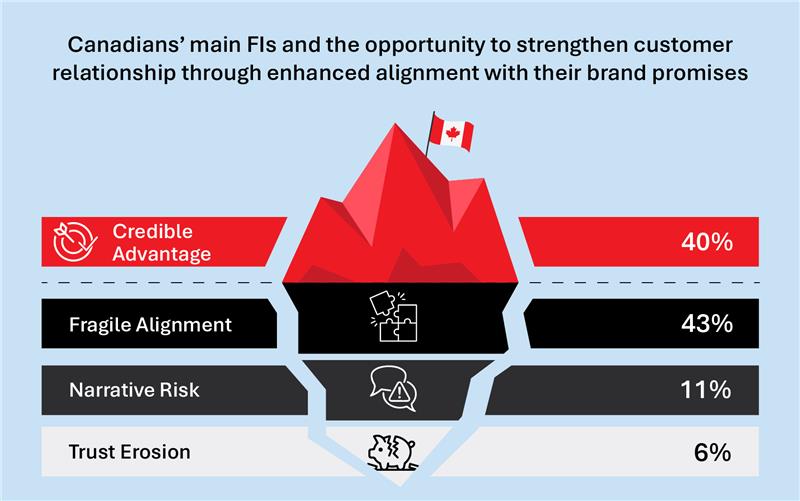
This is where the story gets sharper. Yes, 40% of customers place their main FI in Credible Advantage, but 43% land in Fragile Alignment. This is where risk starts to build. It’s the zone where the brand is running on optimism and habit, not proof. Where one missed paycheque deposit, one unresolved fraud call, or one clumsy mortgage renewal can turn into a switching conversation.
If you lead a bank, credit union, or insurer, you should feel the difference between “we’re fine” and “we’re fragile.” Most don’t lose customers because the organization is bad. They lose customers because they are intermittently disappointing
The “Very” Gap Is Where Brand Equity Leaks Out Quietly
Let’s look at the intensity underneath those strong net scores:
- Only 32% say their institution lives up to its messages very well, while 58% say it mostly lives up.
- Only 40% describe delivery as very consistent, even though 92% give a net consistency score.
That “very vs mostly” gap is not semantics. It’s the difference between credibility you can spend and credibility you keep defending. “Mostly” buys tolerance when nothing goes wrong whereas “very” buys forgiveness when it does. And things do go wrong.
Even with strong net scores, downside risk is measurable: 11% fall into Narrative Risk and 6% into outright Trust Erosion. In an environment where cost-to-serve is rising and Canadian regulatory expectations around fair treatment and complaints are not getting softer, this isn’t a theoretical risk.
Age Is the Fault Line in Today’s Market
If you want to see where promise-resilience breaks first, look at age. The story is blunt.
- Among Canadians aged 65+, 44% say their main FI lives up to its messages very well versus 30% among those aged 18 to 34.
- Credibility follows the same pattern:
- 78% of customers aged 65+ say promises are credible and relevant, compared with 62% of those aged 18 to 34.
This is less about young people being hard to please than about them paying attention. They are not disengaged; they are skeptical and alert.
Seventeen percent of 18 to 34 year olds say their main FI’s promises are relevant but not credible, which makes this a particularly risky combination. Relevance without credibility is not neutral; it can be destabilising. It tells you the customer is listening, but has not granted you permission to make those claims.
And when their FI misses, younger customers do not shrug: half of younger customers place their main FI in Fragile Alignment (50%), while only 34% put it in Credible Advantage. By contrast, 54% of those aged 65+ place their main FI in Credible Advantage. This isn’t stylistic; it’s structural. The brand is living off legacy trust with older Canadians while trying to win future trust with younger Canadians without earning it through consistent proof.
Broken Promises Trigger Predictable Risk Behaviours
When promises are not met, most customers do not leave immediately. Instead, risk accumulates, and their behaviour starts to change.
- 30% become more cautious, but stay
- 13% escalate, but stay
- 7% disengage, but stay
- 5% escalate while considering alternatives
- 21% would lose trust and start considering alternatives
The damage arrives in stages, often invisible to dashboards over-indexed on satisfaction and under-indexed on fragility. That slow bleed in relationship strength is then compounded by skepticism. When customers view promises as relevant but not credible, 36% say they would lose trust and consider alternatives.
Consistency Is a Retention Strategy, Not Just a Brand Standard
The real prize is getting customers to believe your institution rarely drops the ball, even when something goes sideways. That does not mean shortfalls never happen: systems fail, life happens, and in Canadian banking regulation and risk controls can tie your hands, even when you want to say yes. Even so, consistency is one of the clearest relationship safeguards within your control.
When customers experience consistent delivery, 26% say shortfalls rarely occur. When delivery feels inconsistent, that falls to 4%. In other words, inconsistency does not just create more misses. It rewrites the customer’s baseline expectation, so even unavoidable constraints can feel like yet another letdown. Consistency is not the only lever, but it is one of the most bankable ways to protect trust when the inevitable miss happens.
What Canadian Financial Services Leaders Should Do Next
- Govern the brand promise like an operational commitment, not a campaign theme.
Find out where your brand sits then ask yourself a hard question: is your promise a moat or marketing paint? - Run the business on “very,” not on net scores.
“Mostly lives up” and “somewhat consistent” can coexist with rising fragility. Meanwhile, “lives up very well” and “very consistent” are the standards that can buy forgiveness. - Treat recovery as a growth engine, not a cost centre.
When disbelief sets in, disengagement jumps to 25% and switching risk rises to 31%. Complaint handling, proactive communication, and fast remediation become primary-relationship shields. - Stop assuming younger Canadians will simply mature into trust.
With 17% of 18 to 34 year-olds finding their main FI’s promises relevant but not credible, there is a clear proof problem. Fix the experience before you fix the message.
Do the basics brutally well: deliver consistently, explain constraints clearly, and resolve problems quickly when things go wrong. That’s what turns a promise into a moat.
At Leger, we help financial institutions operationalise this. We build and diagnose Promise-Experience Integrity profiles, pinpoint where the promise is fragile by segment, and identify the moments that drive trust erosion.
By Susan Sanei-Stamp
Canadian financial institutions invest real money and real talent in telling Canadians who they are: through purpose statements, brand platforms, and promises about what it feels like to bank with them. Those are the commitments customers will test, especially when rates are high, life is expensive, and patience is thin.
Research from our Financial Services team reveals that, at first glance, the system looks healthy. Nine in ten customers (90%) say their main financial institution (FI) lives up to the messages it puts into market, and 92% say the experience is consistent across channels. If you stop there, it can look like the brand is safe, the experience is aligned, and the machine is humming.
But this is where leaders risk being lulled into the wrong conclusion. “Net strong” is not the same as “resilient under pressure”, and the question isn’t whether you pass. The question is whether you are bankable when it counts. We pressure-tested that topline through our Promise-Experience Integrity Index. It links stated delivery to behavioural risk and client impact by looking at customers across two dimensions:
- Belief in the brand promise
- Consistency of lived brand experiences
Together, these two forces reveal four distinct outcomes:
- Credible Advantage: high belief, high consistency
- Fragile Alignment: belief that is not reinforced by strong, consistent delivery
- Narrative Risk: consistent execution that lacks emotional credibility
- Trust Erosion: breakdown on both fronts, where belief and experience are misaligned
This is where the story gets sharper. Yes, 40% of customers place their main FI in Credible Advantage, but 43% land in Fragile Alignment. This is where risk starts to build. It’s the zone where the brand is running on optimism and habit, not proof. Where one missed paycheque deposit, one unresolved fraud call, or one clumsy mortgage renewal can turn into a switching conversation.
If you lead a bank, credit union, or insurer, you should feel the difference between “we’re fine” and “we’re fragile.” Most don’t lose customers because the organization is bad. They lose customers because they are intermittently disappointing
The “Very” Gap Is Where Brand Equity Leaks Out Quietly
Let’s look at the intensity underneath those strong net scores:
- Only 32% say their institution lives up to its messages very well, while 58% say it mostly lives up.
- Only 40% describe delivery as very consistent, even though 92% give a net consistency score.
That “very vs mostly” gap is not semantics. It’s the difference between credibility you can spend and credibility you keep defending. “Mostly” buys tolerance when nothing goes wrong whereas “very” buys forgiveness when it does. And things do go wrong.
Even with strong net scores, downside risk is measurable: 11% fall into Narrative Risk and 6% into outright Trust Erosion. In an environment where cost-to-serve is rising and Canadian regulatory expectations around fair treatment and complaints are not getting softer, this isn’t a theoretical risk.
Age Is the Fault Line in Today’s Market
If you want to see where promise-resilience breaks first, look at age. The story is blunt.
- Among Canadians aged 65+, 44% say their main FI lives up to its messages very well versus 30% among those aged 18 to 34.
- Credibility follows the same pattern:
- 78% of customers aged 65+ say promises are credible and relevant, compared with 62% of those aged 18 to 34.
This is less about young people being hard to please than about them paying attention. They are not disengaged; they are skeptical and alert.
Seventeen percent of 18 to 34 year olds say their main FI’s promises are relevant but not credible, which makes this a particularly risky combination. Relevance without credibility is not neutral; it can be destabilising. It tells you the customer is listening, but has not granted you permission to make those claims.
And when their FI misses, younger customers do not shrug: half of younger customers place their main FI in Fragile Alignment (50%), while only 34% put it in Credible Advantage. By contrast, 54% of those aged 65+ place their main FI in Credible Advantage. This isn’t stylistic; it’s structural. The brand is living off legacy trust with older Canadians while trying to win future trust with younger Canadians without earning it through consistent proof.
Broken Promises Trigger Predictable Risk Behaviours
When promises are not met, most customers do not leave immediately. Instead, risk accumulates, and their behaviour starts to change.
- 30% become more cautious, but stay
- 13% escalate, but stay
- 7% disengage, but stay
- 5% escalate while considering alternatives
- 21% would lose trust and start considering alternatives
The damage arrives in stages, often invisible to dashboards over-indexed on satisfaction and under-indexed on fragility. That slow bleed in relationship strength is then compounded by skepticism. When customers view promises as relevant but not credible, 36% say they would lose trust and consider alternatives.
Consistency Is a Retention Strategy, Not Just a Brand Standard
The real prize is getting customers to believe your institution rarely drops the ball, even when something goes sideways. That does not mean shortfalls never happen: systems fail, life happens, and in Canadian banking regulation and risk controls can tie your hands, even when you want to say yes. Even so, consistency is one of the clearest relationship safeguards within your control.
When customers experience consistent delivery, 26% say shortfalls rarely occur. When delivery feels inconsistent, that falls to 4%. In other words, inconsistency does not just create more misses. It rewrites the customer’s baseline expectation, so even unavoidable constraints can feel like yet another letdown. Consistency is not the only lever, but it is one of the most bankable ways to protect trust when the inevitable miss happens.
What Canadian Financial Services Leaders Should Do Next
- Govern the brand promise like an operational commitment, not a campaign theme.
Find out where your brand sits then ask yourself a hard question: is your promise a moat or marketing paint? - Run the business on “very,” not on net scores.
“Mostly lives up” and “somewhat consistent” can coexist with rising fragility. Meanwhile, “lives up very well” and “very consistent” are the standards that can buy forgiveness. - Treat recovery as a growth engine, not a cost centre.
When disbelief sets in, disengagement jumps to 25% and switching risk rises to 31%. Complaint handling, proactive communication, and fast remediation become primary-relationship shields. - Stop assuming younger Canadians will simply mature into trust.
With 17% of 18 to 34 year-olds finding their main FI’s promises relevant but not credible, there is a clear proof problem. Fix the experience before you fix the message.
Do the basics brutally well: deliver consistently, explain constraints clearly, and resolve problems quickly when things go wrong. That’s what turns a promise into a moat.
At Leger, we help financial institutions operationalise this. We build and diagnose Promise-Experience Integrity profiles, pinpoint where the promise is fragile by segment, and identify the moments that drive trust erosion.