

Online sexual harm is affecting Canadian teens at an alarming scale, according to a new national survey conducted by Leger for the Canadian Centre for Child Protection.
Based on the lived experiences of 1,279 teens aged 13 to 17 who experienced sexual harm online, the study reveals a digital environment where harm is widespread, often invisible, and insufficiently addressed by platforms. Among other things, it shows that nearly four in five respondents (79%) were subjected to unwanted sexual talk and 86% were harmed in private messaging environments.
Most Common Form of Online Sexual Violence
The most common form of online sexual violence reported by teens is unwanted sexual talk.
-
- 79% of teen victims said someone tried to engage them in sexual conversations they did not want.
- Sexual and gender minority teens were even more likely to experience this (88%), compared with 77% among sexual and gender majority teens.
Experts note that this behaviour is frequently a grooming tactic, used to normalize sexual content and escalate abuse over time.
Adult offenders involved in one quarter of cases
While peer-to-peer abuse remains common, adult involvement is significant, 25% of teen victims reported being sexually victimized online by an adult. Another 21% were unsure whether the offender was an adult, raising concerns about adults posing as teens.
Image-based abuse affects a majority of teen victims
The study also found that 52% of the teens surveyed had been sent unwanted nude photographs or sexual images. These harms often have lasting psychological, emotional, and social consequences.
Image-based sexual violence is both common and varied:
-
- 52% received unwanted nude or sexual images.
- 44% were pressured to send nude or sexual images of themself.
- 23% were threatened with the distribution of real or fake sexual images — a form of sextortion.
- 20% had their images shared without consent.
- 17% had fake nude or sexual images created of them, often using AI tools.
- 15% had real images copied or recorded without their permission.
Powerless victims
Victims must be patient when reporting images showing them naked or in sexually suggestive situations posted on the platforms of web giants. Of teen victims who reported a nude or sexual image of them to an app or platform, 2 in 3 (67%) waited over a day for it to be removed.
Online Sexual Abuse Happens Mostly in Private Digital Spaces
The study shows that Canadian teens are most at risk of online sexual exploitation on mainstream social media and messaging platforms, particularly where private communication features are used. The majority of harmful interactions began in private digital spaces, such as direct messages or closed group chats on Snapchat, Instagram, and Facebook, platforms that allow conversations to quickly move from public spaces into private direct messages. Once interactions shift to private chats, abuse becomes harder to detect and intervene in, increasing the risk for teens.
-
- 86% were harmed in private communication spaces, such as direct messages or closed group chats.
Snapchat tops the list of the most risky web apps for young people
40% of victims surveyed have experienced sexual violence on Snapchat, either in private messaging or via the social network’s public platform.
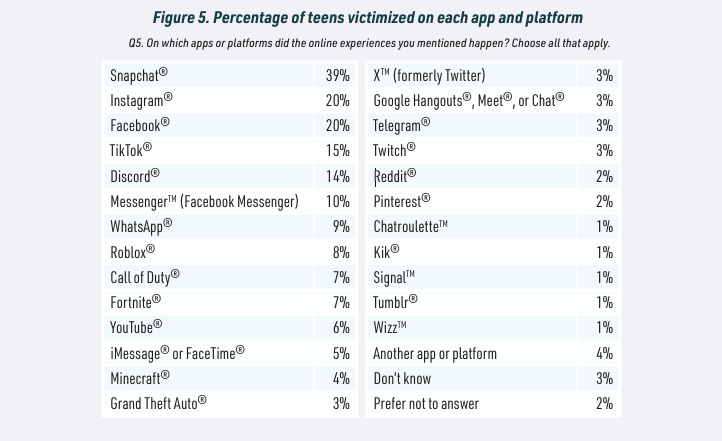
The findings underscore that the issue is not confined to niche or obscure platforms, but rather occurs most frequently on widely used apps that are deeply embedded in teens’ everyday online lives, highlighting the need for stronger safety-by-design measures on major platforms.
Barriers to Reporting and Platform Accountability
Despite the severity of the harm, most teen victims do not report what they experience. Only 20% of teen victims reported the abuse to the platform where it occurred, often due to a lack of confidence that action would be taken.
Teens Call for Stronger Online Safety Laws
Teen victims are clear about what needs to change.
-
- 93% believe Canada should legally require apps and platforms to prevent harm online.
- 74% strongly support such regulation.
The Need to Take Action
The findings reinforce calls for a comprehensive Canadian online safety framework, rather than relying on reactive criminal law after harm has occurred.
“These findings add to the long list of evidence that children in Canada are being preyed upon online and I hope these critically important insights, based on the lived experiences of children in our country, can help contribute to shaping future online safety laws in Canada,” said Lianna McDonald, Executive Director of C3P, in a press release.
Methodology
The survey was conducted online by Leger between April 29 and May 20, 2025, among 1,279 Canadian teens aged 13–17 who had experienced at least one form of online sexual victimization.
Results were weighted by age, gender, and region using 2021 Census data. A comparable probability sample would have a margin of error of ±2.7%, 19 times out of 20.