

This survey explores Canadians’ views on vaccine passports and Canadians’ and Americans’ perceptions surrounding the COVID-19 vaccine, including reasons for hesitancy.
In this edition, we asked Quebecers whether they support the vaccine passport that will be implemented in their province in September, and Canadians who live in provinces outside Quebec whether they support implementing a vaccine passport in their province.
We also explored reasons for not getting a COVID-19 vaccine among Canadians and Americans who do not plan to get one.
This survey is conducted in collaboration with the Association for Canadian Studies (ACS) and published in the Canadian Press. This series of surveys is available on Leger’s website.
Would you like to be the first to receive these results? Subscribe to our newsletter now.
DOWNLOAD THE FULL REPORT AT THE END OF THIS ARTICLE.
Vaccine Passports
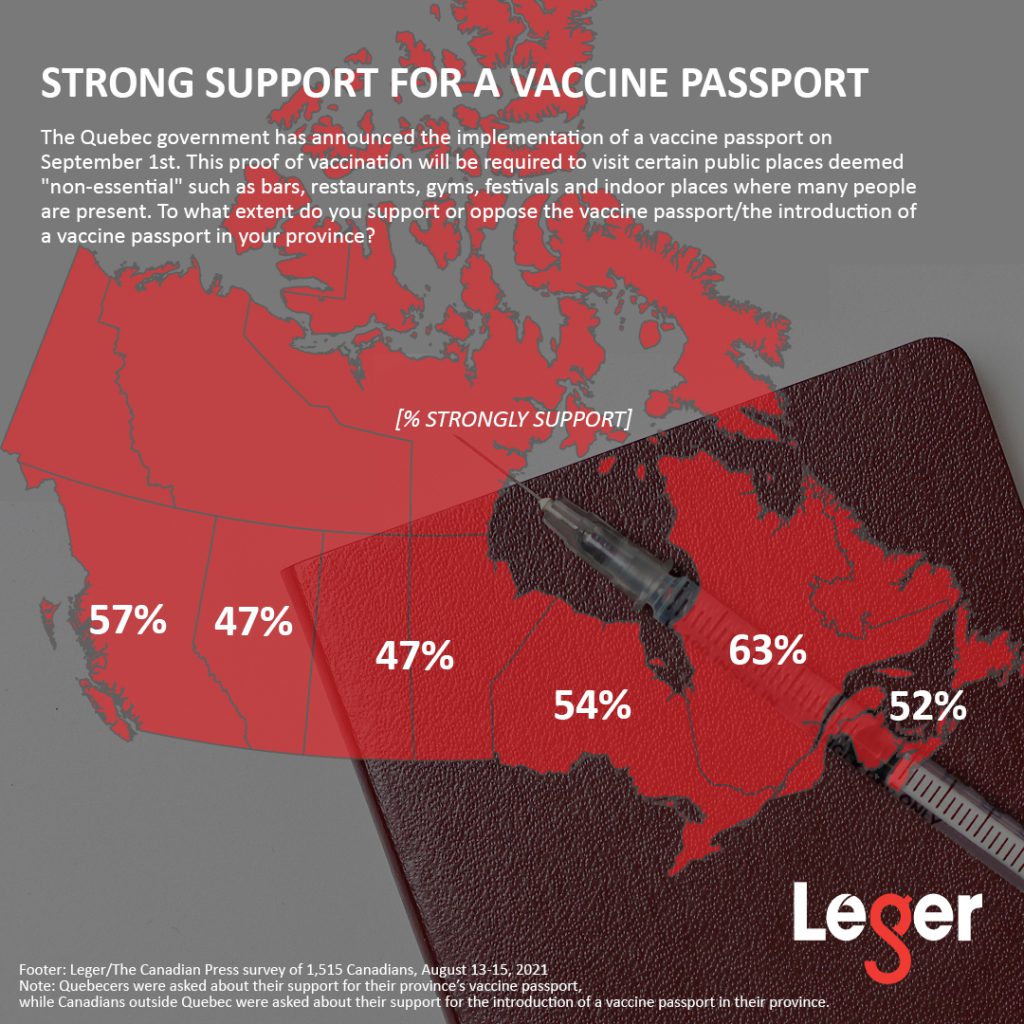
- 63% of Quebecers strongly support the vaccine passport that will be implemented on September 1.
- 53% of Canadians outside of Quebec strongly support implementing a vaccine passport in their province.
Reason for Not Getting the COVID-19 Vaccine
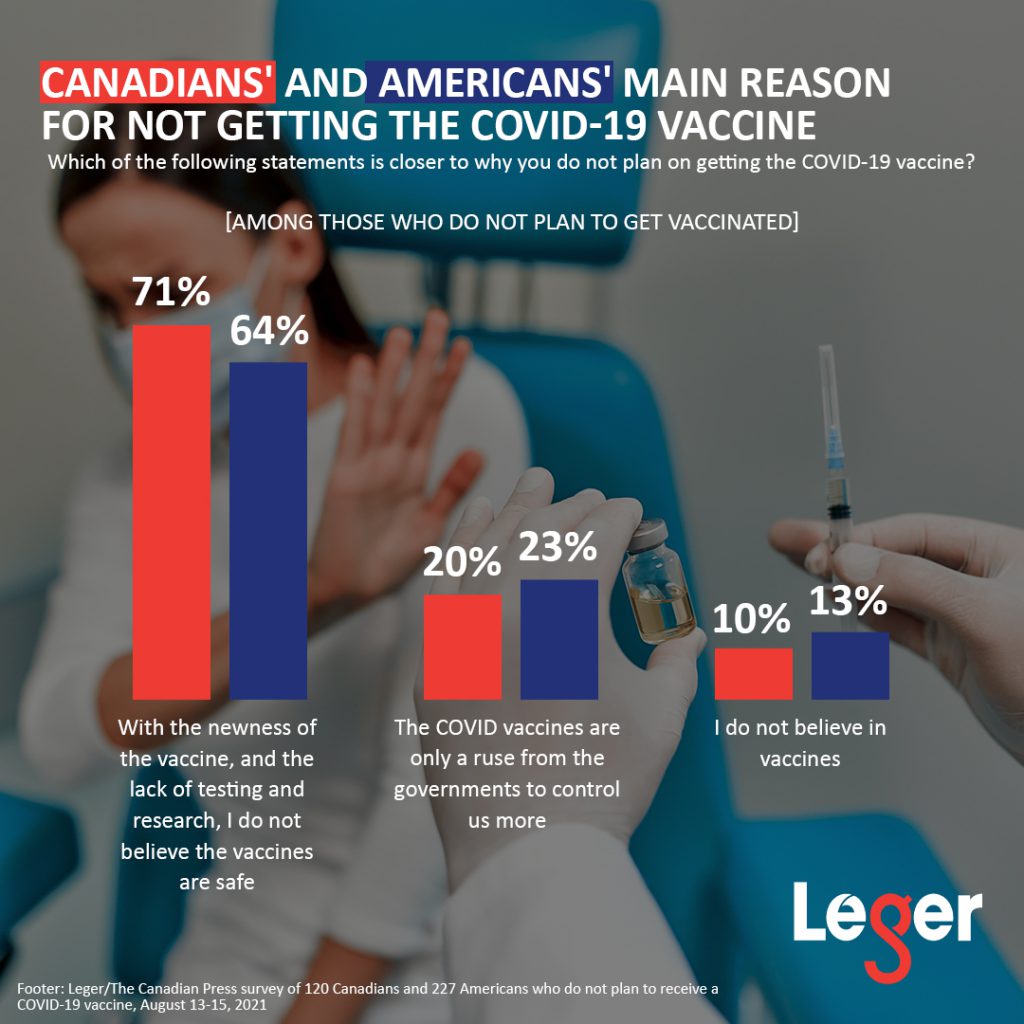
- Among Canadians and Americans who do not plan to get the COVID-19 vaccine, the reason is:
- They do not believe the vaccines are safe (71% of Canadians and 64% of Americans*)
- They think the COVID-19 vaccines are only a ruse from the governments to exert control (20% of Canadians and 23% of Americans*)
- They do not believe in vaccines (10% of Canadians and 13% of Americans*)
*Respondents were allowed to select one option. All figures are shown among Canadians and Americans who do not plan to get the vaccine.
METHODOLOGY
This web survey was conducted from August 13 to August 15, 2021 with 1,515 Canadians and 1,005 Americans, 18 years of age or older, randomly recruited from LEO’s online panel.
For comparison, a probability sample of 1,515 respondents would have a margin of error of ±2.51%, 19 times out of 20, while a probability sample of 1,005 would have a margin of error of ±3.09%, 19 times out of 20.
THIS REPORT CONTAINS THE RESULTS FOR THE FOLLOWING QUESTIONS AND MORE!
- The Quebec government has announced the implementation of a vaccine passport on September 1st. This proof of vaccination will be required to visit certain public places deemed “non-essential” such as bars, restaurants, gyms, festivals and indoor places where many people are present. To what extent do you support or oppose the vaccine passport?
- The Quebec government has announced the implementation of a vaccine passport on September 1st. This proof of vaccination will be required to visit certain public places deemed “non-essential” such as bars, restaurants, gyms, festivals and where many people are present. To what extent would you support or oppose the introduction of a vaccine passport in your province?
- Experts have recently suggested that it may be safer for people who have received a first dose of the AstraZeneca vaccine (COVISHIELD) and then a second dose of another vaccine to receive a third dose. Which of the following statements best describes your opinion on the subject?
- Which of the following statements is closer to why you do not plan on getting the COVID-19 vaccine?