

The government of Canada has recently introduced Bill C-18, which will require web giants like Meta and Google to compensate news media for sharing their articles. As a result, Meta has blocked this type of publications on their platforms in Canada. From September 15 to 17, 2023, we surveyed Canadians about their perceptions of Bill C-18 and its implications on their news consumption.
SOME OF THE KEY HIGHLIGHTS OF OUR SURVEY ABOUT Bill C-18 INCLUDE…
Awareness of Bill C-18 is high among Canadians
- 75% of Canadians are aware of Bill C-18, while 25% are not. Canadians who are 55 years old or older are more likely to say they are familiar with Bill C-18 (84%).
- Nearly half of Canadians (47%) have seen changes in their online feed since Meta blocked news content. This proportion is higher among respondents who mainly get their news via social media (59%) and Quebecers (54%).
Most Canadians believe that news should be free and accessible to anyone
- 66% of Canadians think that news should be free and accessible to anyone, while 34% think Bill C-18 is a good thing since news media are struggling. Those who mainly get their news via social media are more likely (75%) to think that news should be free and accessible to anyone.
- 43% of Canadians support Bill C-18, while 31% are opposed, and 26% don’t know enough about the situation to have an opinion.
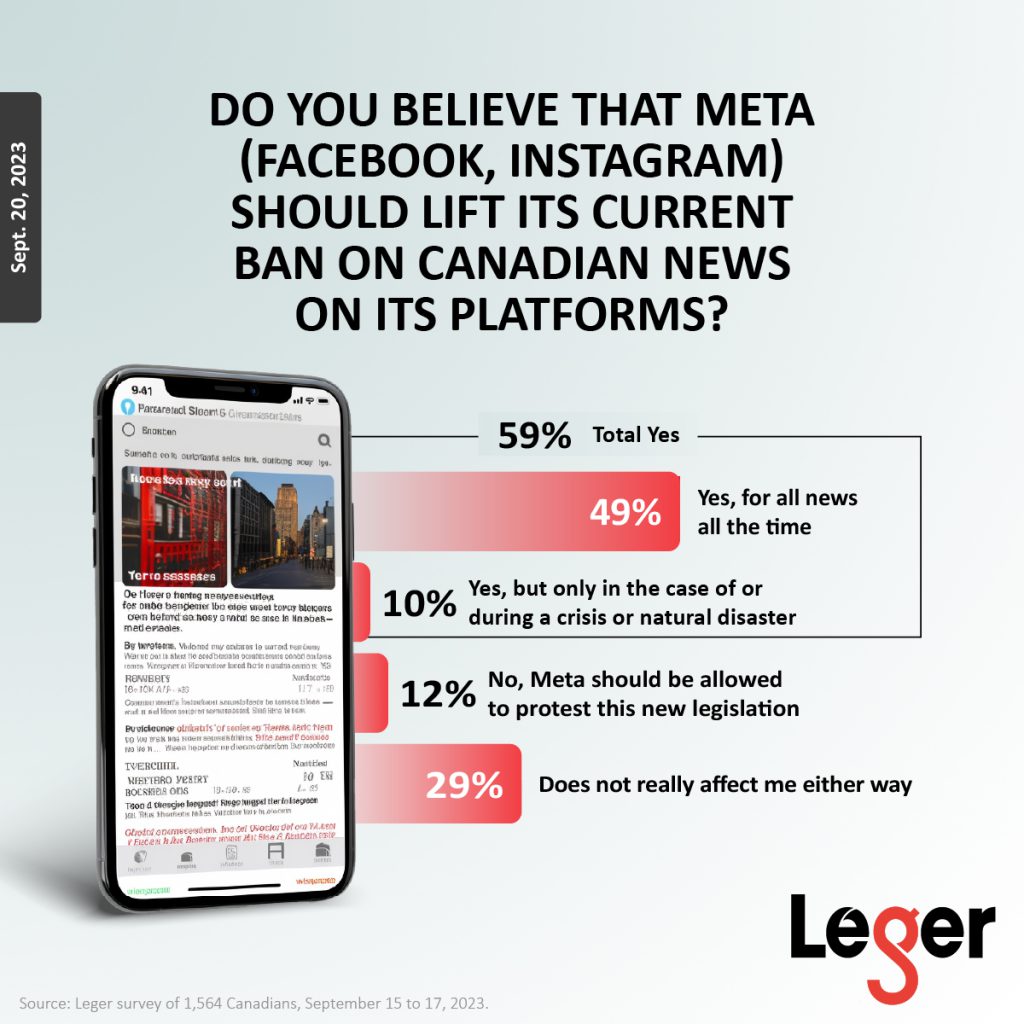
- 59% believe that Meta should lift its current ban on Canadian news on its platforms.
- Since news is blocked on Meta platforms, 22% turn more to radio and television, and 20% to free media websites and applications to access news content. Only 6% of Canadians would pay for a subscription to access news directly.
Download the report to learn more.
SURVEY METHODOLOGY
- 1,564 Canadian residents aged 18 or older were surveyed online using Leger’s LEO online panel from September 15 to 17, 2023.
- Using data from the 2021 Census, the results were weighted according to age, gender, mother tongue, region, education, and presence of children in the household in order to ensure a representative sample of the Canadian population.
- A margin of error should not be associated with a non-probability sample. However, for comparison purposes, a probability sample of 1,564 respondents would have a margin of error of ± 2.5%, 19 times out of 20.