
As Alberta moves further into 2026, the province’s political landscape is being shaped by a mix of shifting voter preferences, economic uncertainty, and persistent pressure on key public services.
Leger’s latest Alberta Report Card points to a growing advantage for the United Conservative Party (UCP), while sentiment toward leadership remains divided and concerns around healthcare, affordability, and the broader economy continue to weigh heavily on Albertans.
Together, these findings highlight a province navigating a complex and increasingly polarized environment—one where political momentum is building, but underlying public sentiment remains cautious.
UCP widens its lead over the NDP
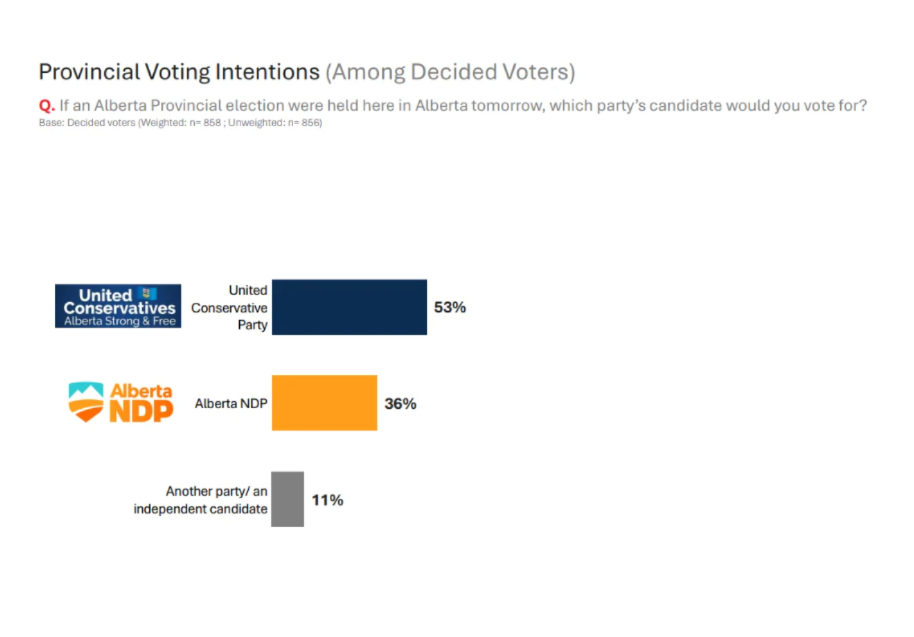
The United Conservative Party (UCP) continues to build on its advantage, with 53% of decided voters indicating support, compared to 36% for the Alberta NDP.
This lead is driven in large part by strong support beyond Alberta’s two largest cities, though the UCP maintains an edge across the province as a whole. The pattern suggests not just a momentary lead, but a broader consolidation of support that may prove difficult for opponents to erode in the near term.
Leadership dynamics begin to diverge
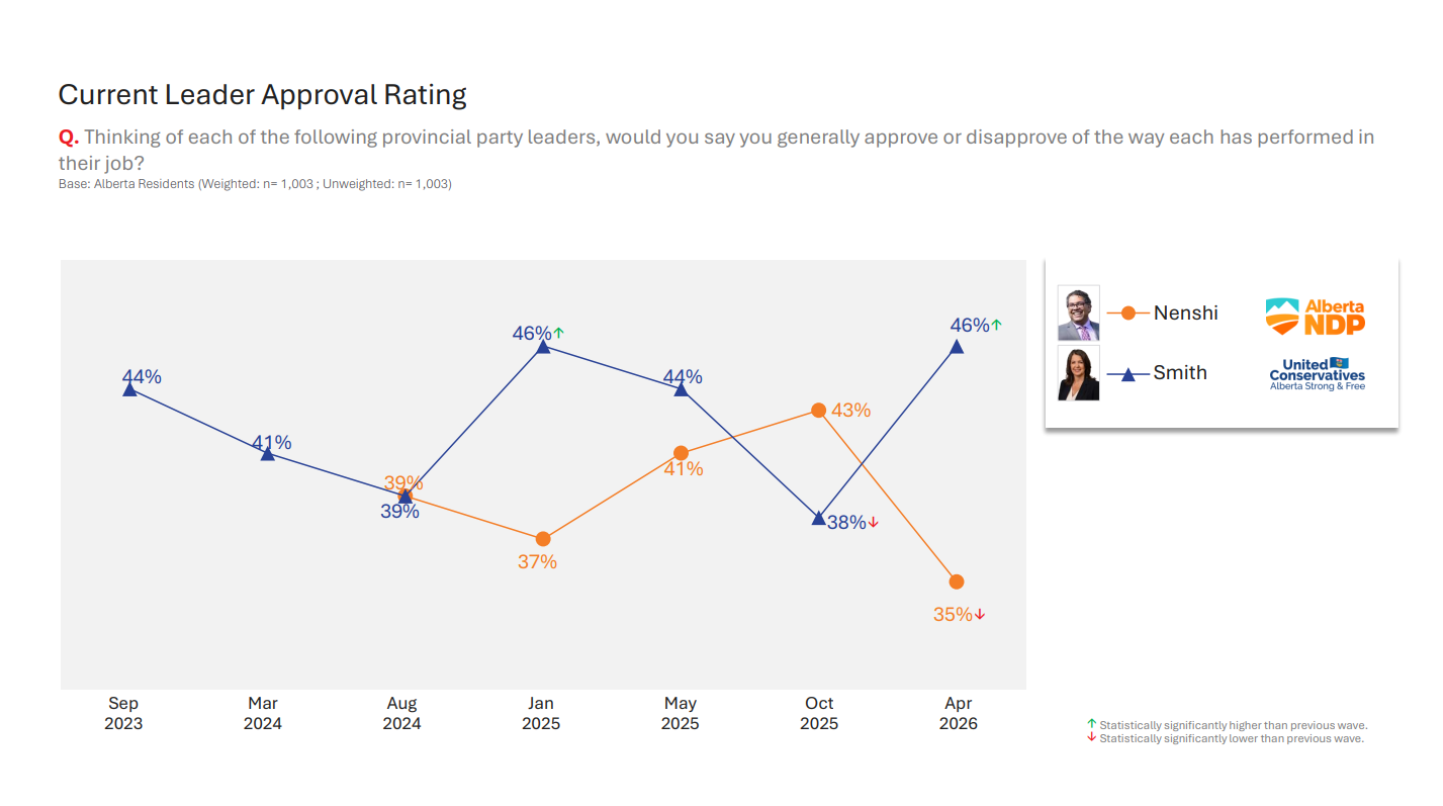
Approval for Premier Danielle Smith has rebounded to 46%, marking a recovery from the declines observed throughout 2025.
In contrast, NDP leader Naheed Nenshi has seen his approval fall to 35%, accompanied by a notable increase in disapproval.
Taken together, these opposing trajectories point to a widening leadership gap—one that reinforces the UCP’s current advantage and suggests a shifting dynamic that could shape voter perceptions in the months ahead.
A province divided: sentiment remains largely negative
Despite evolving political dynamics, public sentiment remains firmly cautious. A majority of Albertans—56%—believe the province is on the wrong track, compared to just 37% who feel it is heading in the right direction.
This perception is deeply polarized along political lines. UCP supporters tend to view the province more positively, while NDP voters overwhelmingly express dissatisfaction. The result is a province not only divided politically, but also in its outlook on the future.
Healthcare, affordability, and the economy remain top of mind
Healthcare continues to dominate the list of concerns, cited by 30% of Albertans as a top issue. It is followed by inflation and rising interest rates (25%), the economy (21%), and provincial nationalism or separatism (16%).
While healthcare remains the leading issue, its relative importance has declined compared to earlier in 2026. This shift suggests that concerns are becoming more diffuse, with economic pressures and broader political questions gaining traction.
Government performance shows modest gains—but challenges persist
Perceptions of government performance remain mixed. Approval levels stay below the 50% threshold across most issues, though there are signs of improvement in specific areas.
Stronger ratings are observed in areas such as:
- Energy and pipelines (51%)
- Wildfire response (47%)
- Transportation and infrastructure (42%)
However, key pressure points remain. Economic management, healthcare, and affordability continue to generate higher levels of disapproval—highlighting a gap between areas of strength and the issues that matter most to Albertans.
Limited appetite for an Alberta Pension Plan
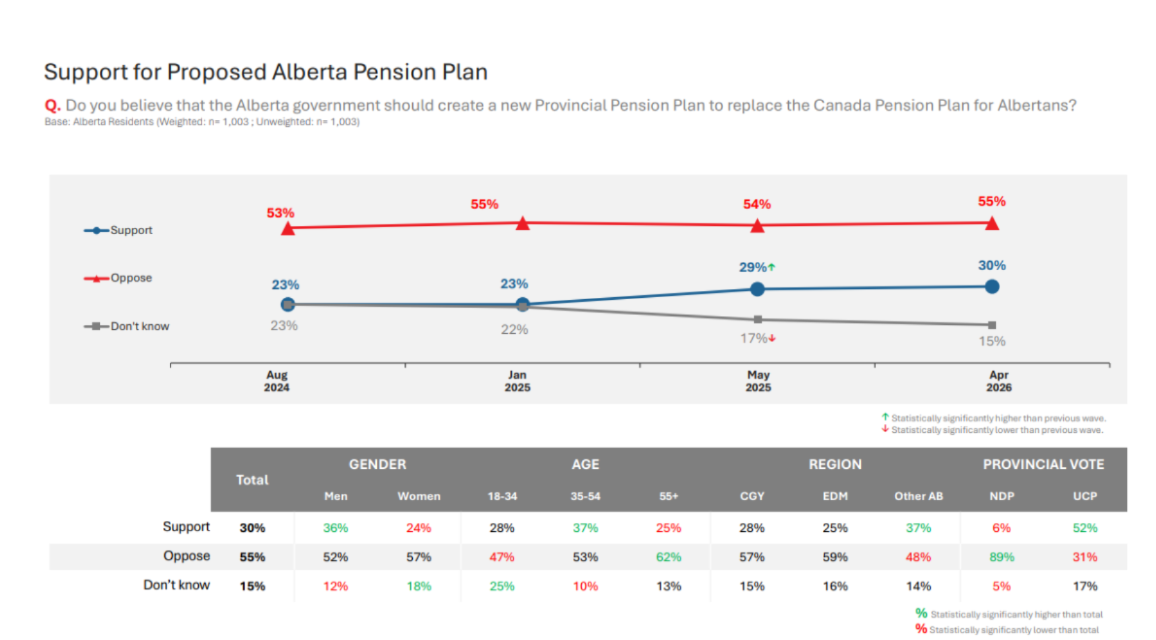
Support for a provincial pension plan remains constrained, with 30% of Albertans in favour and 55% opposed.
These results have remained largely stable over time, suggesting that public opinion on this issue is relatively entrenched. While certain segments show higher levels of support, broad-based momentum for the proposal has yet to materialize.
Fiscal caution continues to shape public opinion
Albertans demonstrate a clear preference for fiscal restraint.
- 37% favour limiting deficits, even if it requires reducing spending
- 27% prioritize balancing the budget quickly
- Only 25% accept deficits to maintain services and investments
At the same time, a majority (54%) support a balanced approach—indicating that while fiscal discipline is important, most Albertans are looking for pragmatic solutions rather than extreme positions.
Rising separatist sentiment—but still a minority position
Support for Alberta becoming an independent country has increased to 23%, while a clear majority—64%—prefer the province remain part of Canada.
Although separatist sentiment has grown, it remains a minority view. At the same time, concern about separatist movements is notable, with 54% of Albertans expressing concern—pointing to an issue that, while not dominant, continues to shape the broader political conversation.
Methodology
This online survey was conducted among 1,003 Alberta residents aged 18 or older, from April 3 to April 6, 2026. Respondents were randomly recruited through LEO’s online panel. Results were weighted by age, gender, region, and education to reflect the population of Alberta.
A margin of error cannot be associated with a non-probability sample in a panel survey. For comparison purposes, a probability sample of this size would have a margin of error of ±3.1%, 19 times out of 20.