
As British Columbia moves through 2026, the political race remains tight, but the mood of the province tells a more nuanced story.
Beneath the surface of a competitive landscape, a growing sense of pressure is taking hold, driven by concerns around affordability, access to health-care, and confidence in government performance.
Leger’s latest British Columbia Report Card captures this moment of imbalance: the NDP holds a narrow lead, yet the foundations of that support appear increasingly fragile.
At the same time, ongoing reforms, such as changes to the province’s health-care regulatory system—are bringing longstanding challenges into sharper focus, revealing the complexity of the issues shaping public opinion.

A narrow NDP lead underscores an increasingly competitive race
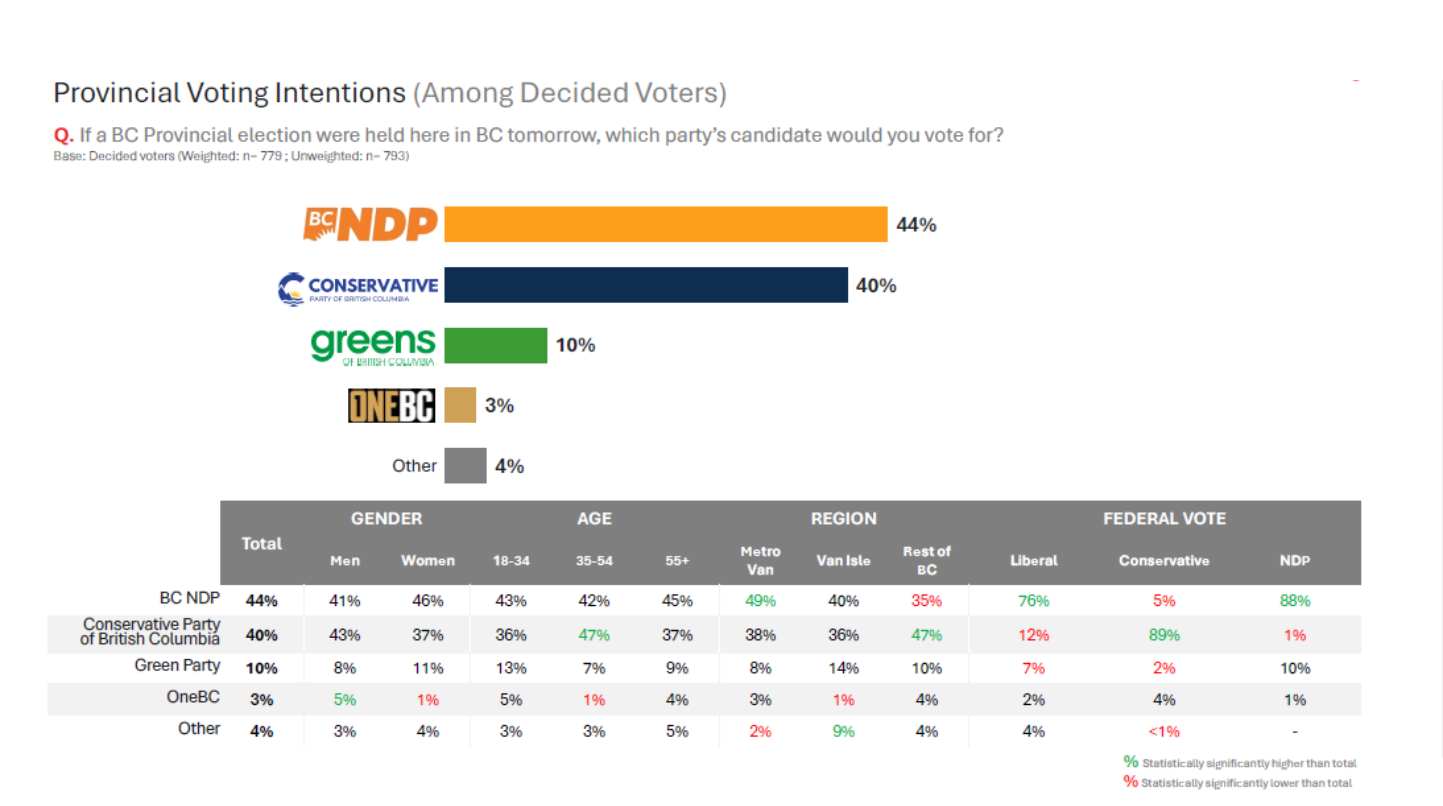
If a provincial election were held today, the BC NDP would hold a narrow advantage, capturing 44% of the vote compared to 40% for the Conservatives.
The closeness of this result underscores a race that remains highly competitive and far from settled—where even modest shifts in public opinion could have significant political implications.
Slipping momentum begins to offset leadership strength
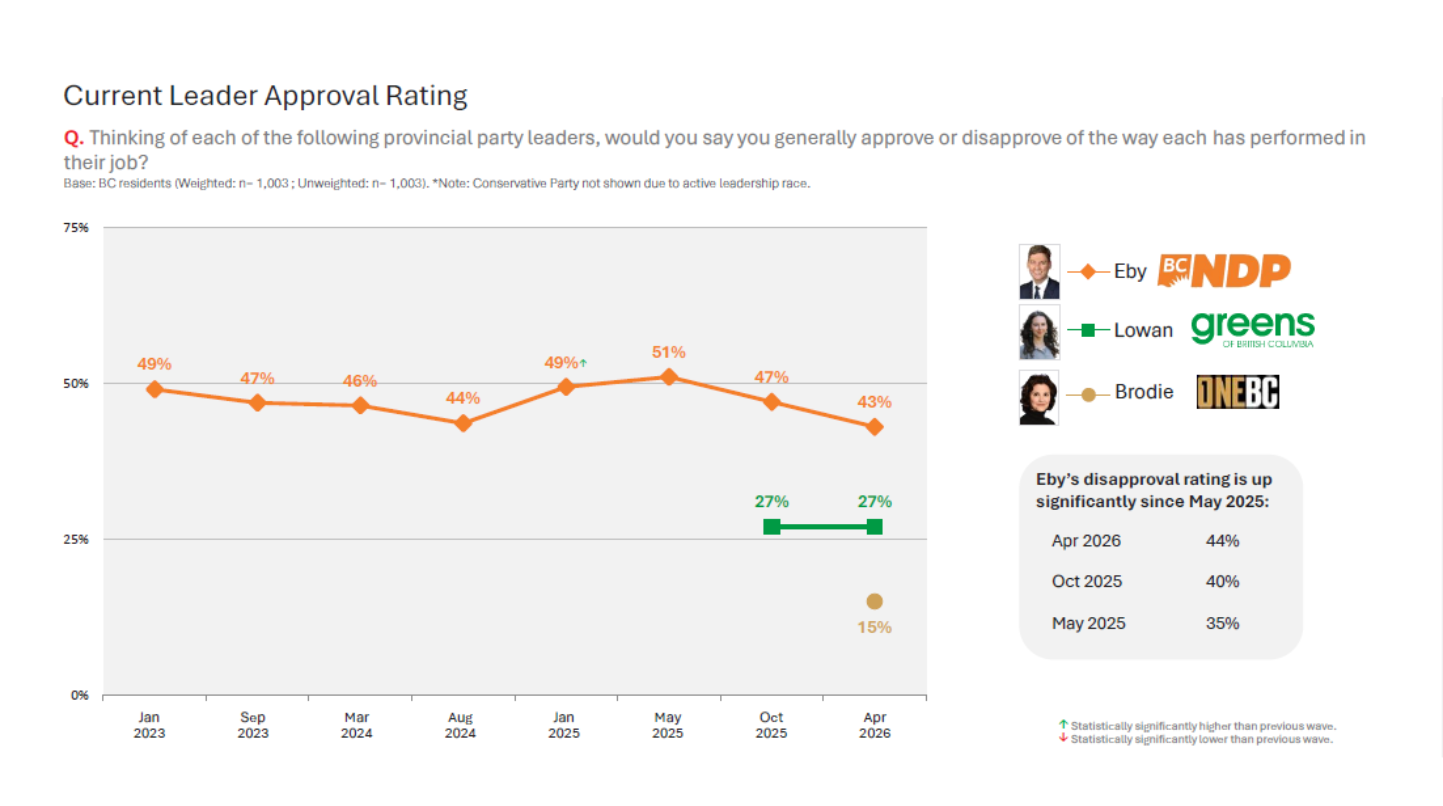
At 43% approval, Premier David Eby continues to outperform other party leaders by a wide margin. Yet the underlying trend is less stable. Disapproval has increased significantly, and perceptions of his leadership have become more negative over time. This points to a shift in the role of leadership for the NDP. While still a strength, it may no longer provide the same cushion against broader public concerns.
A cautious mood persists, but polarization is becoming more pronounced
More than half of British Columbians, 54%, say the province is on the wrong track, while 37% believe it is moving in the right direction. These views break cleanly along political lines. Optimism is concentrated among NDP supporters, while pessimism dominates among Conservative voters. What emerges is a province that is not only politically competitive, but also deeply divided in how it understands its path forward.
Housing and healthcare rise together as intertwined priorities
Housing affordability (30%) and healthcare (29%) remain the two defining issues for British Columbians. Their prominence is closely linked. Access to stable housing is widely understood as a key driver of both physical and mental health, reinforcing the connection between the two. At the same time, structural changes within the healthcare system, including new regulatory reforms aimed at improving accountability, underscore both the urgency and the complexity of the challenge. Beyond these top concerns, economic pressures such as inflation and broader economic conditions continue to shape a second tier of voter priorities.
Government delivery falls short on key issues
Across every major issue, approval of the BC government remains below the 50% mark. More positive ratings are concentrated in areas like wildfire response (47%) and emergency preparedness (40%). On priority concerns such as housing, healthcare, and the economy, however, approval falls off significantly. The disconnect is clear. Gains in operational performance are not carrying over into public confidence where it counts most.
Limited impact from Conservative leadership race
The Conservative leadership race has yet to influence voter intentions in a meaningful way. Candidate awareness remains low, and no frontrunner has emerged. As it stands, the race is unlikely to significantly shift the competitive landscape in the short term.
DRIPA remains a defining—and divisive—policy issue
Public opinion on the Declaration on the Rights of Indigenous Peoples Act (DRIPA) is closely divided, with no clear consensus:
- 39% support
- 38% oppose
- 23% remain unsure
This near-even split highlights a deeply polarized landscape, reflecting broader political divisions and an ongoing, often contentious, public debate around reconciliation.
Recent political discourse, including renewed commitments to advance reconciliation despite criticism, reinforces just how central this issue has become. It remains a defining and contested element of British Columbia’s policy agenda.
Fiscal concerns and perceptions of overspending are rising
Economic anxiety is not limited to affordability. It is increasingly tied to how the government is perceived to be managing public finances:
- 46% say the government is spending too much
- Just 10% believe it is managing the budget responsibly
Despite these concerns, most British Columbians are not calling for extremes:
- 53% favour a balanced approach to taxes, deficits, and services
- 35% prioritize deficit reduction, even if it means spending cuts
The underlying signal is clear. Voters are wary of current fiscal management, but their preferences remain grounded in moderation and practical trade-offs.
Methodology
This online survey was conducted among 1,003 BC residents aged 18 or older from April 3 to April 6, 2026, using Leger’s LEO online panel. Results were weighted by age, gender, region, and education to reflect the population of British Columbia.
A margin of error cannot be associated with a non-probability sample in a panel survey. For comparison, a probability sample of this size would have a margin of error of ±3.1%, 19 times out of 20.