
Alberta politics has been moving fast in recent weeks. The provincial agenda has been pulled in different directions at once.
Against that backdrop, Leger’s latest Government of Alberta Report Card shows a province that feels uneasy about its direction, but not fundamentally realigned. Among decided voters, the UCP leads with 48% versus 36% for the Alberta NDP. At the same time, 60% say Alberta is on the wrong track, and only 31% say it is headed in the right direction.
Voters are weighing affordability and services, watching new autonomy proposals take shape, and judging whether political tactics are building leverage or eroding trust.

UCP remains ahead, Danielle Smith’s approval rating remains low
In recent weeks, much of the national focus on Alberta politics has turned to issues such as provincial autonomy and national unity.
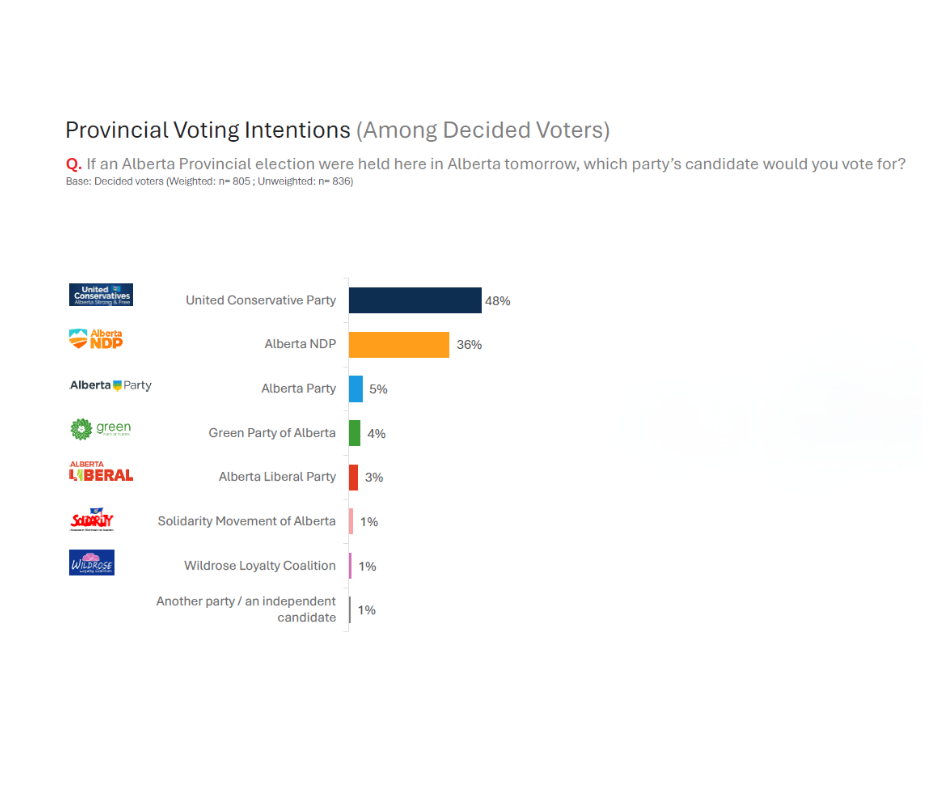
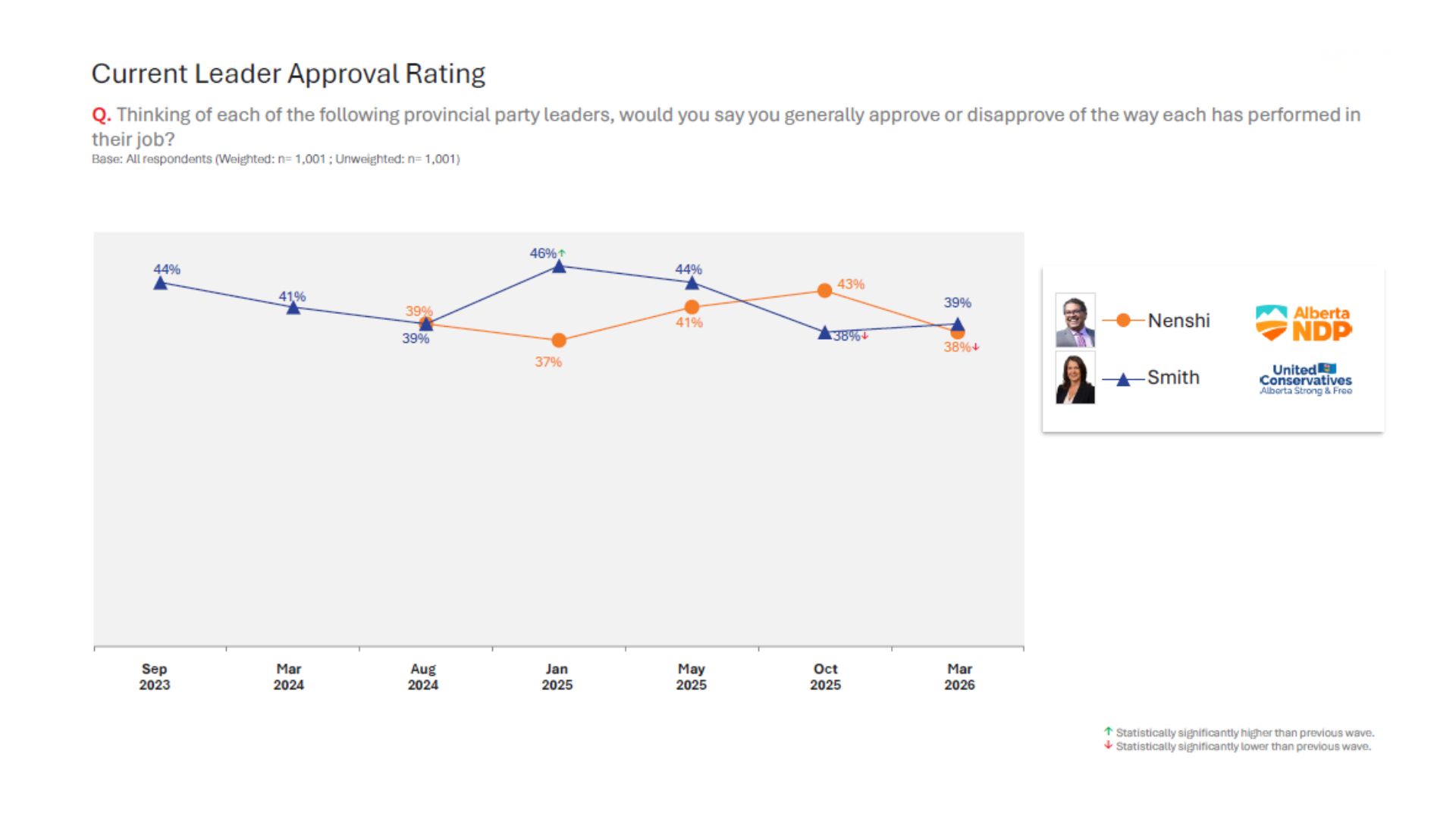
On the surface, the UCP remains ahead in voting intentions with 48% — a two-point drop from Leger’s previous pulse check in January. But leader standing is not as dominant. Danielle Smith’s approval is 39%, while Naheed Nenshi’s (NPD) is close behind at 38%.
Where Albertans stand on sovereignty and separation
The data suggests a careful public mood. Most Albertans want Alberta to remain part of Canada at 70%. Support for independence sits at 17%, while 4% would rather join the United States. Yet concern about separatist movements gaining influence remains significant at 58%. In plain terms, separation is not the majority view, but the issue is not fading either.
-
- UCP Voters are far more likely to support independence (30%) while NDP voters are more likely to want Alberta to remain part of Canada (96%).
Nearly six-in-ten (58%) Albertans are concerned about separatist movements in the province, consistent with results from January 2026, with NDP voters having much higher concern rates (80%) than UCP voters (41%).
What issues matter most to Albertans
Health care continues to dominate the agenda. It is the top issue at 24%. When first and second choice issues are combined, health care remains the clear leader at 40%.
Cost pressures are also persistent. The economy comes in at 13% as the top issue, and inflation and rising interest rates at 10%. When first and second choices are combined, economy and inflation both reach 23%, and housing affordability reaches 18%.
Policy temperature checks
The report also tested several proposals related to eligibility and costs for non permanent residents. Across the measures, support sits around six in ten.
-
- Restrict eligibility to citizens, permanent residents, and certain legal statuses: 63% support.
- Require a 12 month residency period before eligibility for social supports: 65% support.
- Charge reasonable fees or premiums for health care and education: 63% support.
Views on the Alberta Pension Plan
Views on the Alberta Pension Plan remain largely negative and stable. A majority of Albertans oppose creating an APP at 55%, compared with 25% who support the idea, with support dipping slightly since October 2025.
-
- Resistance is strongest among older Albertans, with 66% of those aged 55+ opposed, and among women, where support sits at just 19%.
-
- The issue is also highly polarized politically. 90% of Alberta NDP voters oppose an Alberta Pension Plan, while UCP voters are more divided, with 43% in support and 33% opposed.
Methodology
This online survey was conducted among 1,001 Canadian residents aged 18 or older, between March 2 to March 4, 2026. Respondents were randomly recruited through LEO’s online panel. Results were weighted according to age, gender, region and education to ensure a representative sample of the population of Alberta.
A margin of error cannot be associated with a non-probability sample in a panel survey. For comparison, a probability sample of this size would have a margin of error of ±3.1%, 19 times out of 20.