

As Canada grapples with a period of intense political debate — including renewed controversy over the federal agreement with Alberta to fast-track construction of a new pipeline — the latest Leger survey on federal politics, conducted for Postmedia, shows that Prime Minister Mark Carney continues to enjoy relatively stable support across the country.
Despite ongoing criticism around energy policy, military decisions, and federal spending, Carney maintains a clear advantage over his opponents, both in job satisfaction and perceived leadership.

Some of the Key Highlights
Federal Voting Intentions: Stability at the Top
Compare to our previous survey, voting intentions remain mostly stable. If an election were held today, the Liberal Party of Canada would receive 43% of the vote among decided voters, maintaining its lead over the Conservative Party at 36% (-2 points). The Bloc gains two points (9%), and the NDP edges up one point (8%). The Green Party remains at 4%.
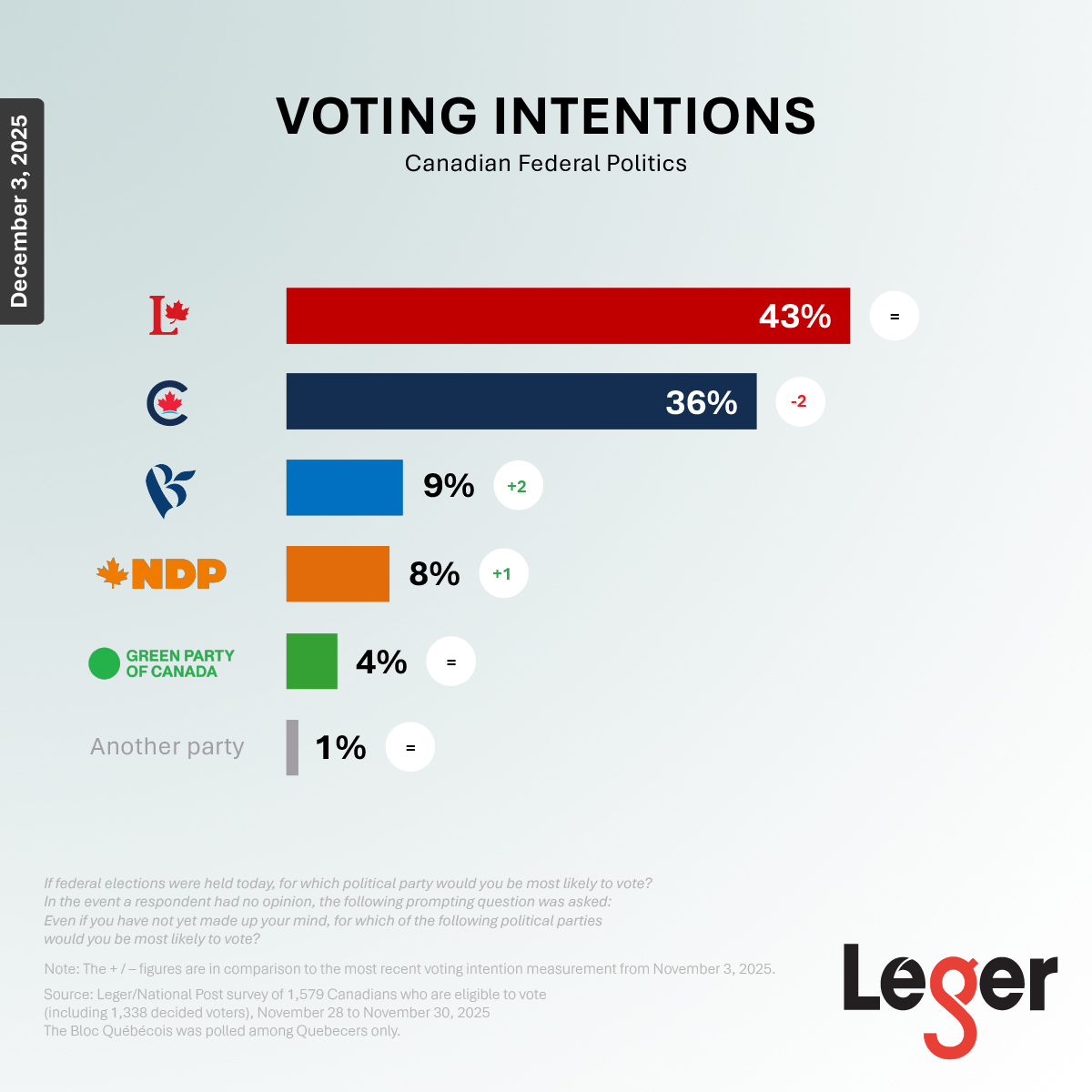
This stability suggests that recent political events — debate and passing of the 2025 Budget, Conservative resignations and floor crossings and a second round of major project announcements — have had little measurable impact on overall party standings.
Carney Government: Satisfaction Remains Solid
Nearly half of Canadians (49%) say they are satisfied with the Carney government, compared with 40% who are dissatisfied.
Approval of Carney’s personal performance sits at 51%, while 38% disapprove.
Support is especially strong among:
-
- Canadians aged 55+ (51% approval)
- Atlantic Canada (54%)
- Liberal voters (92%)
Poilievre Remains Polarizing as Partisans Divide Sharply Over His Future
Nationally, 49% of Canadians believe Pierre Poilievre should step down, while 32% say he should remain as leader.
The split is sharply partisan:
-
78% of Conservative voters want him to stay,
-
77% of Liberals, 74% of New Democrats, and 62% of Bloc voters want him replaced.
The findings underline Poilievre’s position as a high-influence but polarizing figure, whose national appeal remains limited compared to Carney’s.
Opposition Leaders Fail to Gain Traction
Satisfaction with the federal opposition leaders remains low overall.
- Pierre Poilievre: 31%
- Elizabeth May: 26%
- Yves-François Blanchet: 19%
- Don Davies: 17%
Although Poilievre is significantly stronger in the West — notably 48% satisfaction in Alberta — he struggles to build broader national confidence.
When asked “Who would make the best prime minister?”, Canadians responded:
-
- Mark Carney: 40%
- Pierre Poilievre: 28%
- Don Davies: 4%
- Elizabeth May: 4%
Men and younger voters (18–34) are more divided, but Carney still holds a clear lead in every major demographic segment.
Military Decisions & Defense Policy
Overall perception of the Canadian Armed Forces
-
57% hold positive impressions of the Canadian Armed Forces, especially among male respondents (62%).
- Only 7% hold a negative opinion.
Does the Forces place too much emphasis on DEI initiatives?
Canadians are evenly split:
-
- 37% say DEI receives too much emphasis
- 37% disagree
- 26% are unsure
Military spending
In the long-running debate over whether Canada should proceed with purchasing F-35 fighter jets — especially given recent Canada–U.S. tensions — Canadians remain divided:
-
- 20% say proceed with the planned F-35 purchase
- 30% prefer buying a non-U.S. aircraft
- 18% prefer a mixed fleet
- 32% remain unsure.
Also, 50% believe the federal government should prioritize buying military equipment that can be produced or manufactured in Canada by Canadian workers, while 29% prefer focusing on the best and most cost-effective equipment, regardless of where it is made.
Strong Majority Would Support Sending Troops if a NATO Ally Were Attacked
If NATO ally such as Poland were attacked, 66% of Canadians would support sending Canadian troops.
Support is highest among:
-
- Liberal voters (84%)
- Canadians aged 55+ (75%)
- Residents of Manitoba and Saskatchewan (75%)
- Those with a positive impression of the Armed Forces (77%)
Methodology
This online survey was conducted among 1,579 Canadian residents aged 18 or older, between November 28 and November 30 2025. Respondents were randomly recruited through LEO’s online panel. Results were weighted by age, gender, region, language, education, and household composition. A margin of error cannot be associated with a non-probability sample in a panel survey. For comparison, a probability sample of this size would have a margin of error of ±2.47%, 19 times out of 20.
This survey is the property of Leger/Postmedia. All mentions of this survey must respect copyright laws by including the following mention: Leger/Postmedia.