

This survey explores Canadians’ and Americans’ perspectives on returning to work.
The relaxation of COVID-19 safety measures in many provinces and states is prompting Canadian and American employers and employees to contemplate what returning to work will look like post-pandemic.
This survey is conducted in collaboration with the Association for Canadian Studies (ACS) and published in the Canadian Press. This series of surveys is available on Leger’s website.
Would you like to be first to receive these results? Subscribe to our newsletter now.
DOWNLOAD THE FULL REPORT AT THE END OF THIS ARTICLE.
Returning to Work
- 82% of Canadians and 85% of Americans who worked/are still working from home during the pandemic say their experience was/has been positive.
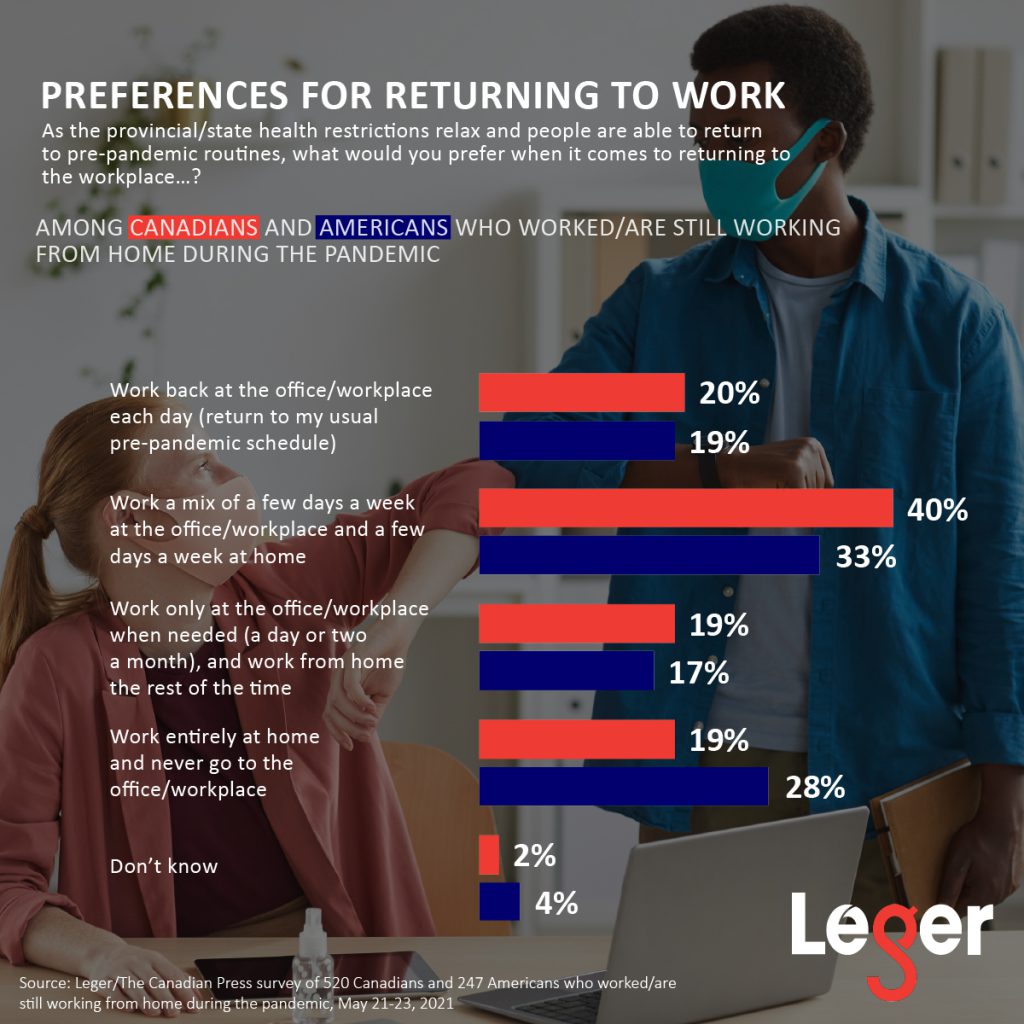
- When it comes to returning to the workplace, among Canadians and Americans who worked/are still working from home during the pandemic:
- 40% of Canadians and 33% of Americans would prefer working a mix of a few days a week at their workplace and a few days a week at home.
- Only 20% of Canadians and 19% of Americans want to stop working from home and go back to their workplace entirely.
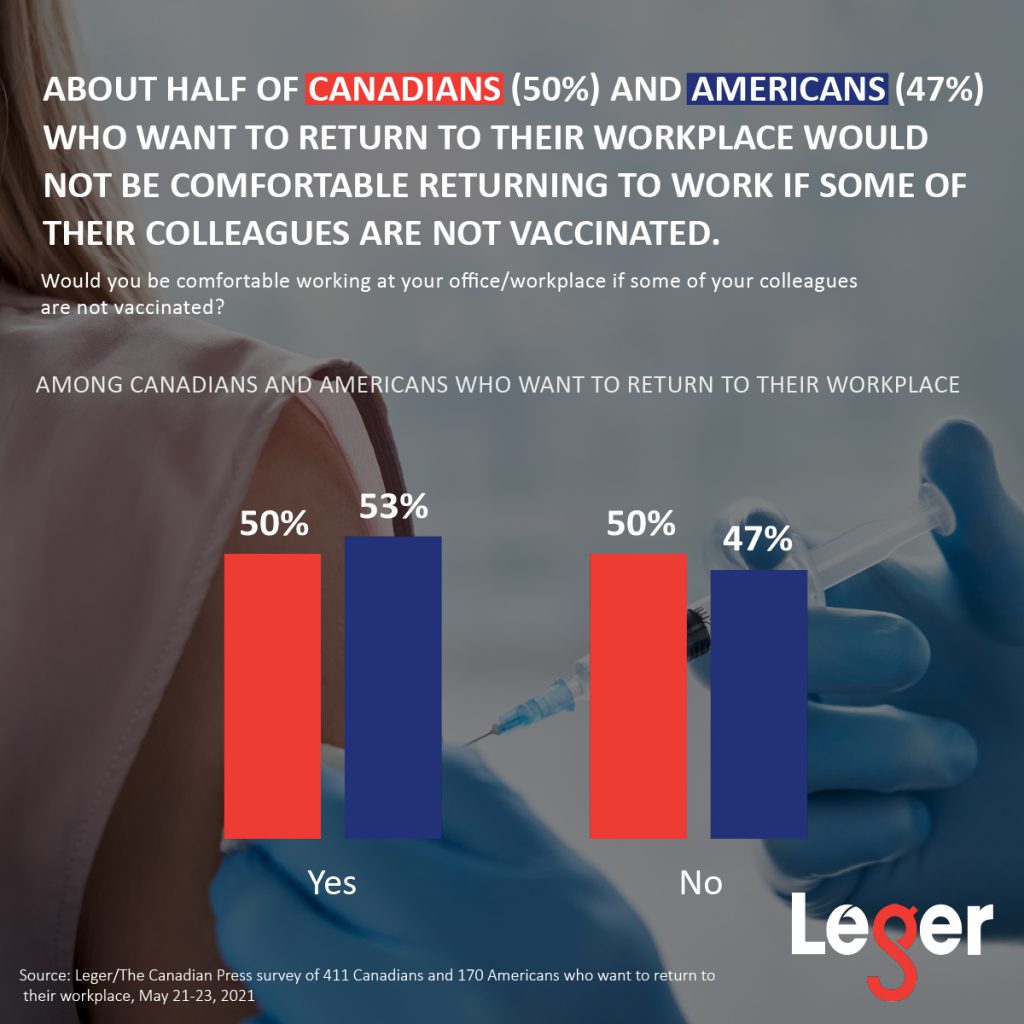
- About half of Canadians (50%) and Americans (47%) who want to return to their workplace would not be comfortable returning to work if some of their colleagues are not vaccinated.
- 35% of Canadians and 39% of Americans who worked/are still working from home during the pandemic agree that if their superiors ordered them to return to the office, they would start to look for another job where they can work from home.
METHODOLOGY
This web survey was conducted from May 21, 2021 to May 23, 2021 with 1,624 Canadians and 1,002 Americans, 18 years of age or older, randomly recruited from LEO’s online panel.
For comparison, a probability sample of 1,624 respondents would have a margin of error of ±2.43%, 19 times out of 20, while a probability sample of 1,002 would have a margin of error of ±3.09%, 19 times out of 20.
THIS REPORT CONTAINS THE RESULTS FOR THE FOLLOWING QUESTIONS AND MORE!
- What is your current work situation?
- Since the pandemic began in March of last year, how many months have you worked from home?
- How would you describe your experience working from home?
- As the provincial/state health restrictions relax and people are able to return to pre-pandemic routines, what would you prefer when it comes to returning to the workplace…?
- Would you be comfortable working at your office/workplace if some of your colleagues are not vaccinated?