

This survey explores Canadians’ and Americans’ perspectives on lifting safety measures, showing proof of vaccination, and returning to “normal.”
With COVID-19 safety measures beginning to relax in many provinces and states, we asked Canadians and Americans how anxious they are about returning to how things were pre-pandemic.
This survey is conducted in collaboration with the Association for Canadian Studies (ACS) and published in the Canadian Press. This series of surveys is available on Leger’s website.
Would you like to be first to receive these results? Subscribe to our newsletter now.
DOWNLOAD THE FULL REPORT AT THE END OF THIS ARTICLE.
Lifting Safety Measures
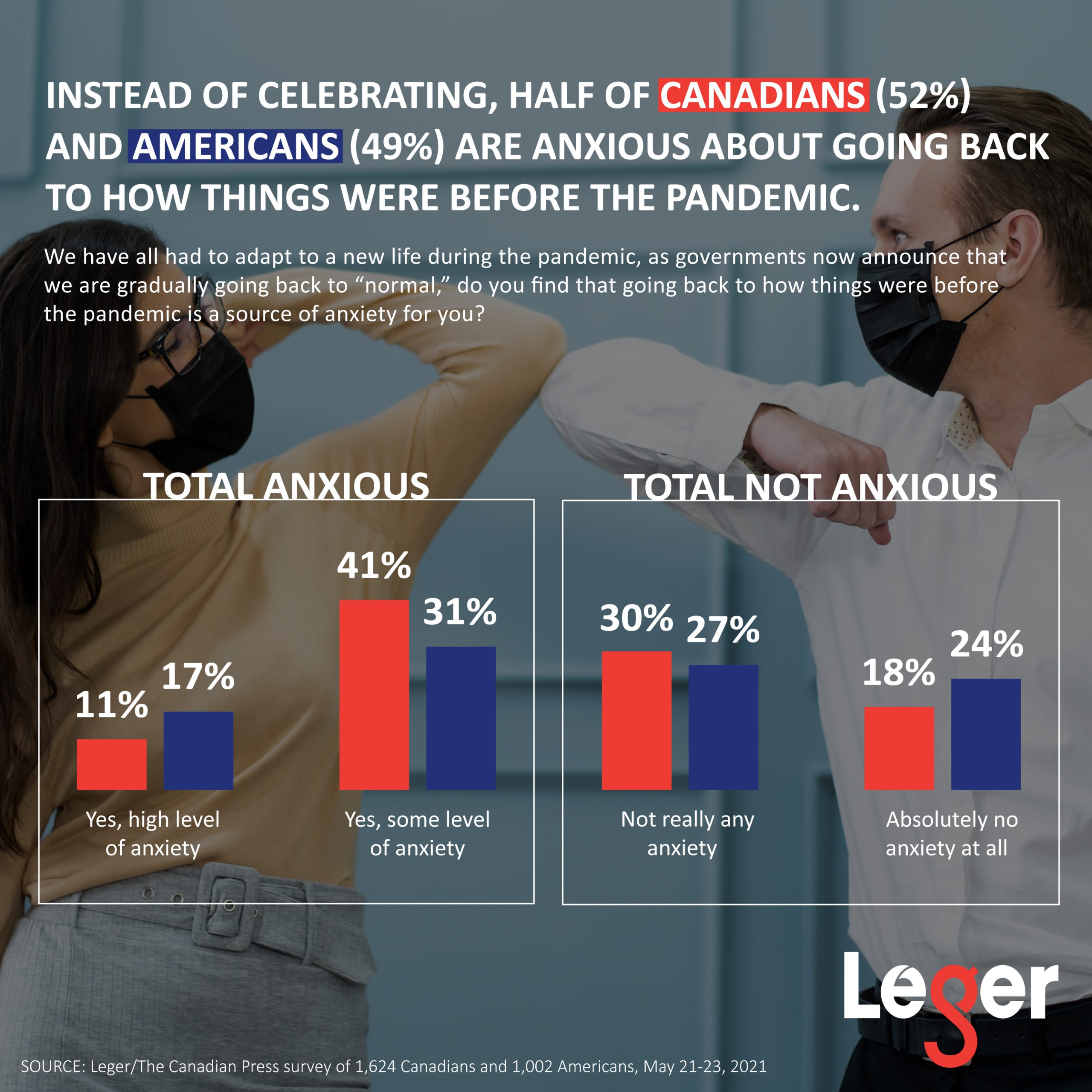
- Instead of celebrating, half of Canadians (52%) and Americans (49%) are anxious about going back to how things were before the pandemic.
- 27% of Canadians think the plans their premier has announced to ease COVID-19 safety measures are going too fast, 53% think they are proceeding at the right pace, and 20% think they are not going fast enough.
- 44% of Canadians and 49% of Americans think that the safety measures put in place by their provincial/state government over the past year were tough but appropriate given the context.
Showing Proof of COVID-19 Vaccination
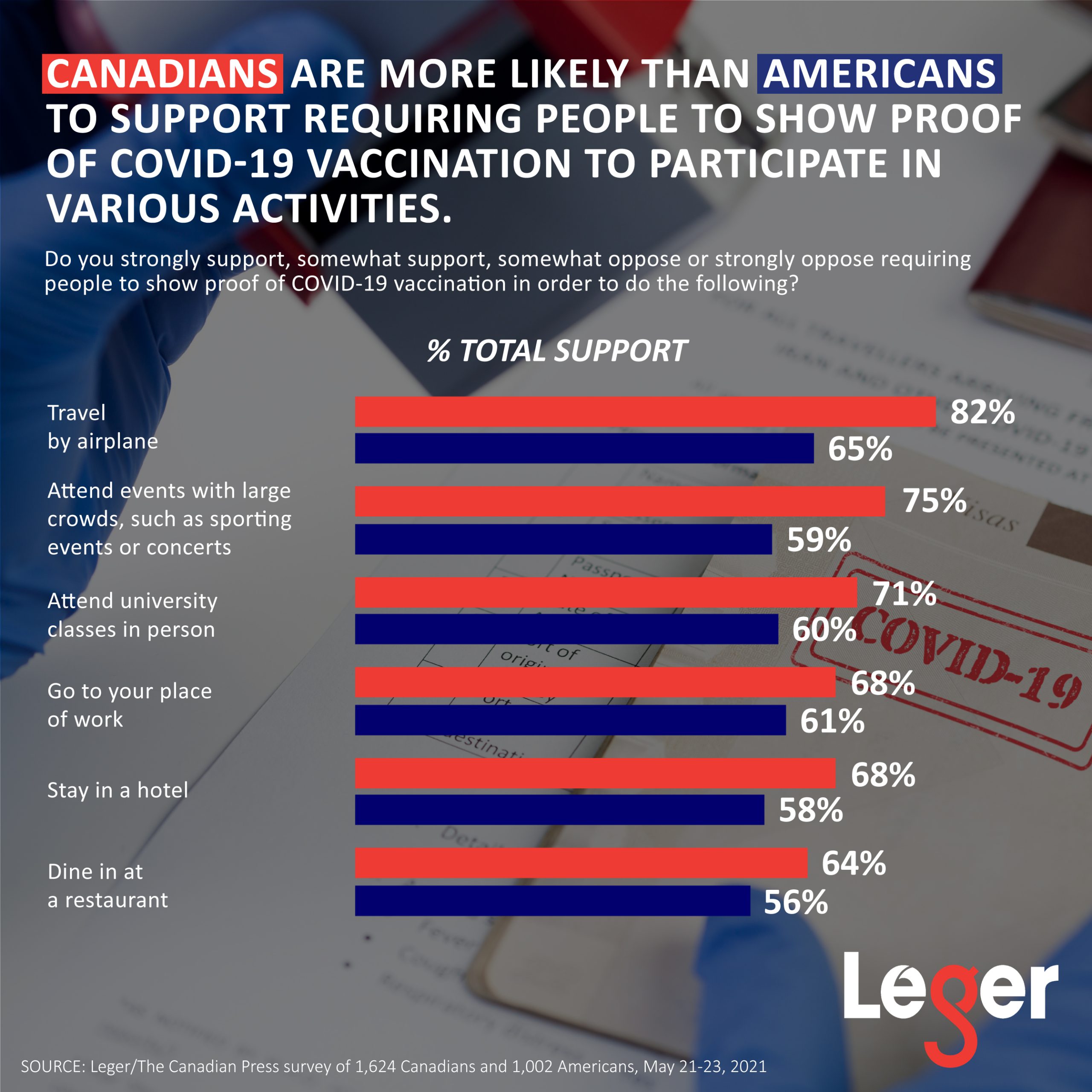
- Canadians are more likely than Americans to support requiring people to show proof of COVID-19 vaccination to participate in various activities.
Fear of Contracting the Coronavirus
- Canadians’ fear of contracting the coronavirus (48% afraid) is at its lowest point since the start of the pandemic.
METHODOLOGY
This web survey was conducted from May 21, 2021 to May 23, 2021 with 1,624 Canadians and 1,002 Americans, 18 years of age or older, randomly recruited from LEO’s online panel.
For comparison, a probability sample of 1,624 respondents would have a margin of error of ±2.43%, 19 times out of 20, while a probability sample of 1,002 would have a margin of error of ±3.09%, 19 times out of 20.
THIS REPORT CONTAINS THE RESULTS FOR THE FOLLOWING QUESTIONS AND MORE!
- Now that many provinces/states have announced plans to relax some safety measures and reopen portions of their economy, do you believe the plans to ease safety measures announced by your premier/governor are going too fast, at the right pace, or not fast enough?
- Now that plans to relax safety measures have started and looking at the progression of the vaccination campaign, thinking of the past year (12 months), do you believe that the safety measures put in place by your provincial/state government were…
- We have all had to adapt to a new life during the pandemic, as governments now announce that we are gradually going back to “normal,” do you find that going back to how things were before the pandemic is a source of anxiety for you?
- Compared to other provinces/states, do you believe the vaccination campaign in your province/state is doing better, about the same or is slower?
- Do you feel optimistic about the next year for Canada/the United States?