

For years, the customer journey followed a simple funnel: a need emerged, research began, options were compared and a decision was made. Brands understood where they fit in that process and which levers mattered most at each stage.
That framework no longer holds up once artificial intelligence enters the picture.
AI is changing how the customer journey unfolds by compressing it, reshaping it and, in many cases, replacing entire parts of it. More and more often, consumers are turning to AI to generate ideas, understand their options, compare more efficiently and validate their choices. In a matter of seconds, a single interaction can now do the work of several steps that once required much more time and effort.
AI Is Already Part of How People Shop
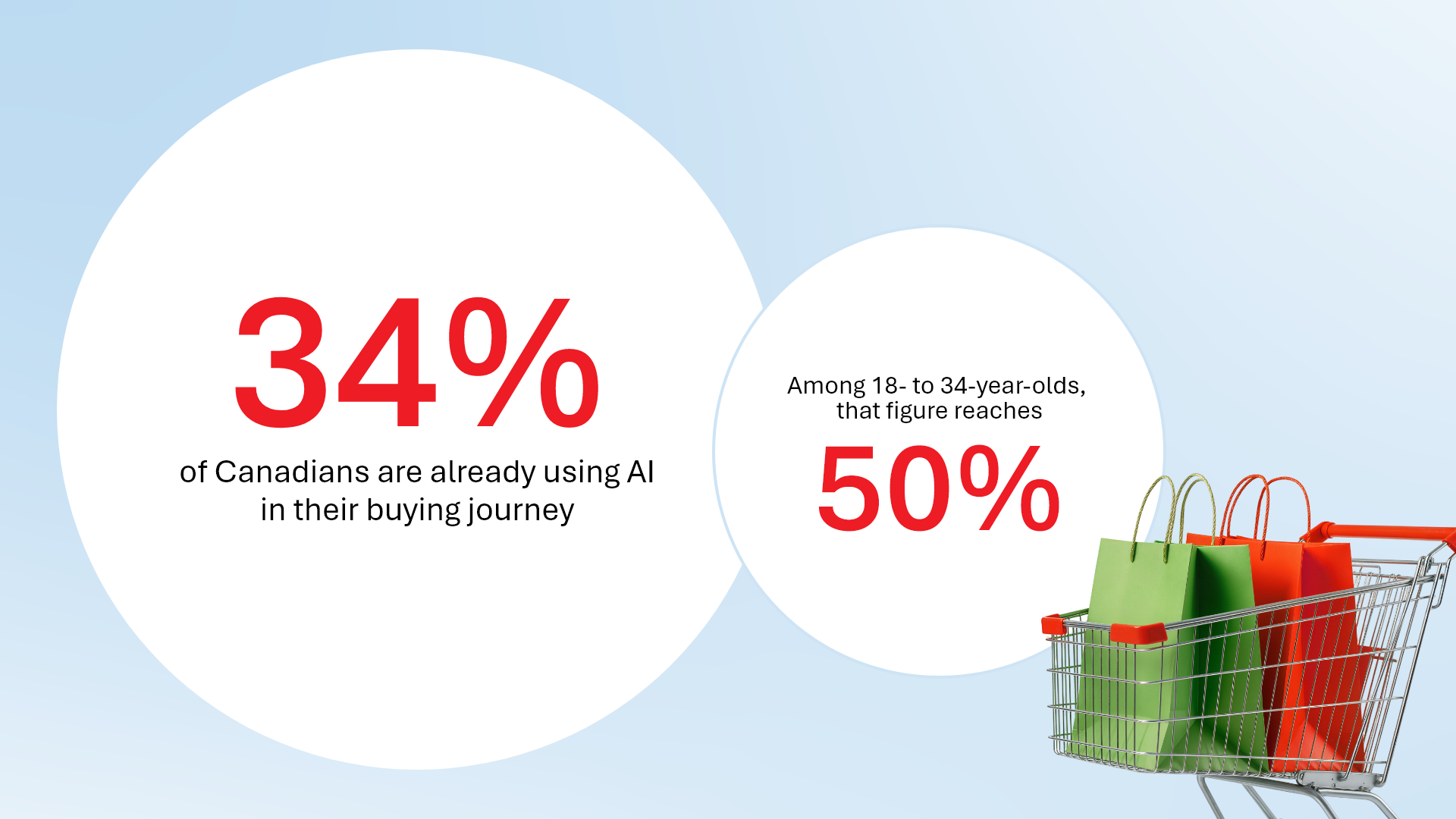
According to a recent Leger study, more than one-third of Canadians have used AI to support a purchase decision in the past three months. Among 18- to 34-year-olds, that rises to nearly one in two. Using AI to shop, compare and validate choices is quickly becoming second nature.
AI Gains Ground Where Shoppers Need More Guidance
AI does not gain traction equally across every category. It becomes more useful when a purchase feels more involved, more unfamiliar or more consequential. The more variables there are to weigh, the more room there is for AI to step in.
According to our study, consumers use AI more often when shopping in the following categories:
- Education and courses
- Baby and children’s products
- Sports and outdoor gear
- Travel and accommodations
- Home renovation, DIY and gardening
What these categories have in common is a greater need for reassurance and guidance. They often involve higher stakes, more uncertainty, and more pressure to make the right choice. Baby products are a clear example: for new parents, the category can feel overwhelming, especially when social media adds a constant stream of conflicting advice.
By contrast, AI plays a smaller role in more routine or impulse-driven categories such as groceries and food products, lottery and gambling, or restaurants and other food services.
The pattern is clear: the more effort a decision requires, the more likely AI is to become a meaningful touchpoint.
AI is Becoming Most Influential Where Decisions Take Shape
AI is already changing what consumers expect from the buying experience.
They are looking for faster, simpler decision-making with less friction throughout the process. And once an easier experience takes hold, it quickly becomes the standard.

Leger’s data also shows that AI becomes especially valuable as the journey becomes more involved. It helps consumers find inspiration and generate ideas (45%), then better understand their needs (52%). From there, it supports the stages that often turn intent into action: researching information (73%), comparing options (70%), narrowing down a final set of choices (46%) and validating the decision before purchase (41%).
The challenge for brands has evolved. Showing up in search results is only part of the equation. Brands now need to be useful in the conversations happening between consumers and AI.
Google, Websites, Reviews: AI is Already Short-circuiting Traditional Touchpoints
Consumers who use AI say they now rely less on digital sources than they used to throughout the buying journey. The sources most affected are:
- Search engines like Google (56%)
- Brand websites (34%)
- Retailer websites (27%)
- Social media searches (25%)
- Comparison or review sites (21%)
- Videos or influencer content (16%)
AI is increasingly positioning itself between consumers and the sources they once consulted directly.
It is also narrowing the number of brands people seriously consider. Where search engines once exposed consumers to a wide range of possibilities, AI now filters earlier, structures information and guides decisions more quickly toward a short list of recommendations.
For brands, that changes the competitive landscape in a fundamental way. A digital presence alone carries less weight than it used to. Brands need to be clear, credible, well-structured and relevant enough to make that shortlist.
The Real Rhift: Brands Are Now Competing Inside the AI Conversation
One of the most important shifts underway is that brands are no longer communicating only with consumers. They are also showing up in AI systems that filter, summarize, compare and recommend.
Part of what makes that shift so significant is trust. Conversational AI can feel more responsive, more tailored and more helpful than traditional digital touchpoints. As a result, consumers are increasingly relying on it to interpret information and guide decisions.
For years, that confidence came mainly from brands, experts, friends and family, or customer reviews. Now, some of it is moving toward AI tools that organize and shape those same sources. That gives AI a more influential role in determining which brands are considered, compared and ultimately chosen.
Visibility still matters, but it no longer guarantees consideration. Brands now need to earn a place on the shortlist AI considers relevant at the exact moment a decision is taking shape.
That is Exactly Where Leger Can Help
We help brands understand where AI is influencing decisions, how they appear in those moments and which levers they can activate to stand out more effectively.
Ultimately, the question is no longer just whether your brand is visible. It is whether your brand is still part of the conversation when the decision is being made.