
Imagine a shopper looking for a new running shoe. Instead of scrolling through retailer websites, comparing dozens of models and reading customer reviews, they ask an AI assistant to recommend the best options for their needs and budget.
Seconds later, they have a shortlist of three products, complete with a comparison of their features. Better yet, the recommendations are tailored to their preferences, drawing on the information they’ve shared and, potentially, their previous interactions with AI.
For the shopper, it’s convenient. For retailers, it challenges everything they know about the traditional consumer journey, as some brands may never even make the shortlist.
Artificial intelligence is beginning to reshape how consumers discover, evaluate and choose products. According to our 2026 AI Index, 46% of AI users say the technology has already influenced a purchase decision.
The implications go beyond adopting new technology. As AI becomes an intermediary between consumers and brands, retailers may need to rethink how they earn visibility, build consideration and ultimately win customers’ trust.

The Biggest Change in Retail Is Happening Before Shoppers Reach the Store
Retailers have spent years investing in visibility through search rankings, advertising, optimized websites and memorable in-store experiences. Those investments remain important, but AI introduces another layer between a shopper’s need and the brands they encounter.
A consumer searching for hiking boots can now describe their budget, experience level and preferred terrain in a single conversation. Instead of browsing a dozen products, they can ask AI to compare the trade-offs and recommend a few options worth considering.
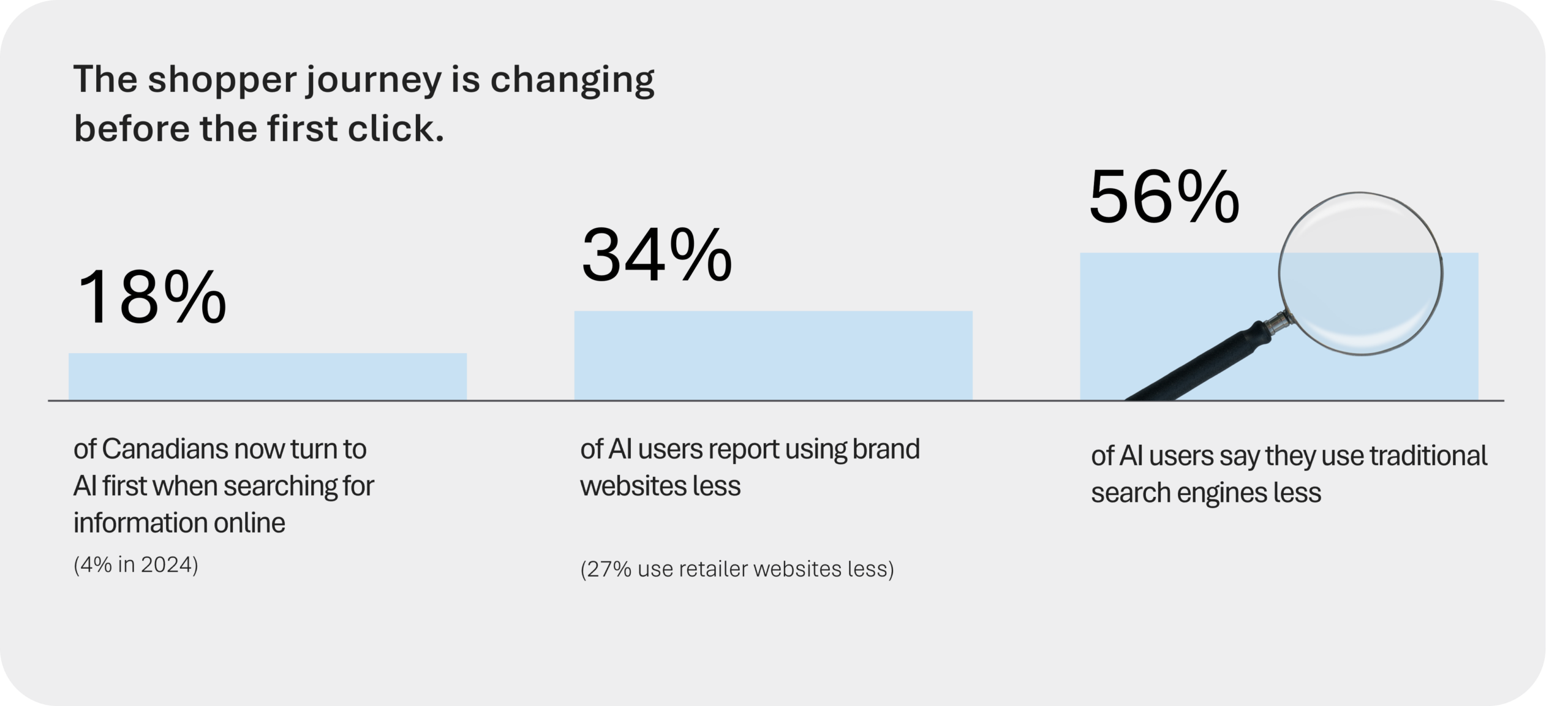
Our findings suggest the starting point is already shifting. 18% of Canadians now turn to AI first when searching for information online, up from 4% in 2024. Among AI users, 56% say they use traditional search engines less, 34% use brand websites less and 27% use retailer websites less. These are self-reported changes in behaviour, not a direct measure of website traffic, but they point to a different route to discovery.
The competitive challenge is shifting from being easy to find to being relevant enough to be recommended by AI. A brand can have a polished website and still be absent from a recommendation if its products are difficult to understand or compare in the information AI can access.
For retail teams, product content is therefore more than a merchandising detail. Accurate specifications, clear differentiators, current prices and credible reviews help both shoppers and AI tools assess fit. Google’s guidance for AI-era commerce similarly emphasizes detailed, accurate product information. The goal isn’t to chase a guaranteed place in an AI answer, but to make the brand easier to evaluate when a shopper asks a specific question.
AI Matters Most When the Decision Gets Complicated
Not every shopping journey needs an AI assistant. Rebuying a familiar grocery item is different from choosing a stroller, planning a renovation or evaluating technical outdoor equipment.
Our AI Customer Journey research finds greater AI use in more involved categories, including baby and children’s products, sports and outdoor gear, travel and home improvement, and lower use in categories such as groceries and restaurant services. The potential value of AI appears greater when shoppers have more options to weigh or more uncertainty to resolve.
Previous Canadian shopper research adds a practical explanation. Among shoppers who had recently used AI for shopping, 46% said it helped them find products faster, 43% said it helped them compare options and prices, and 40% said it saved time. The common thread is decision support, not technology for its own sake.
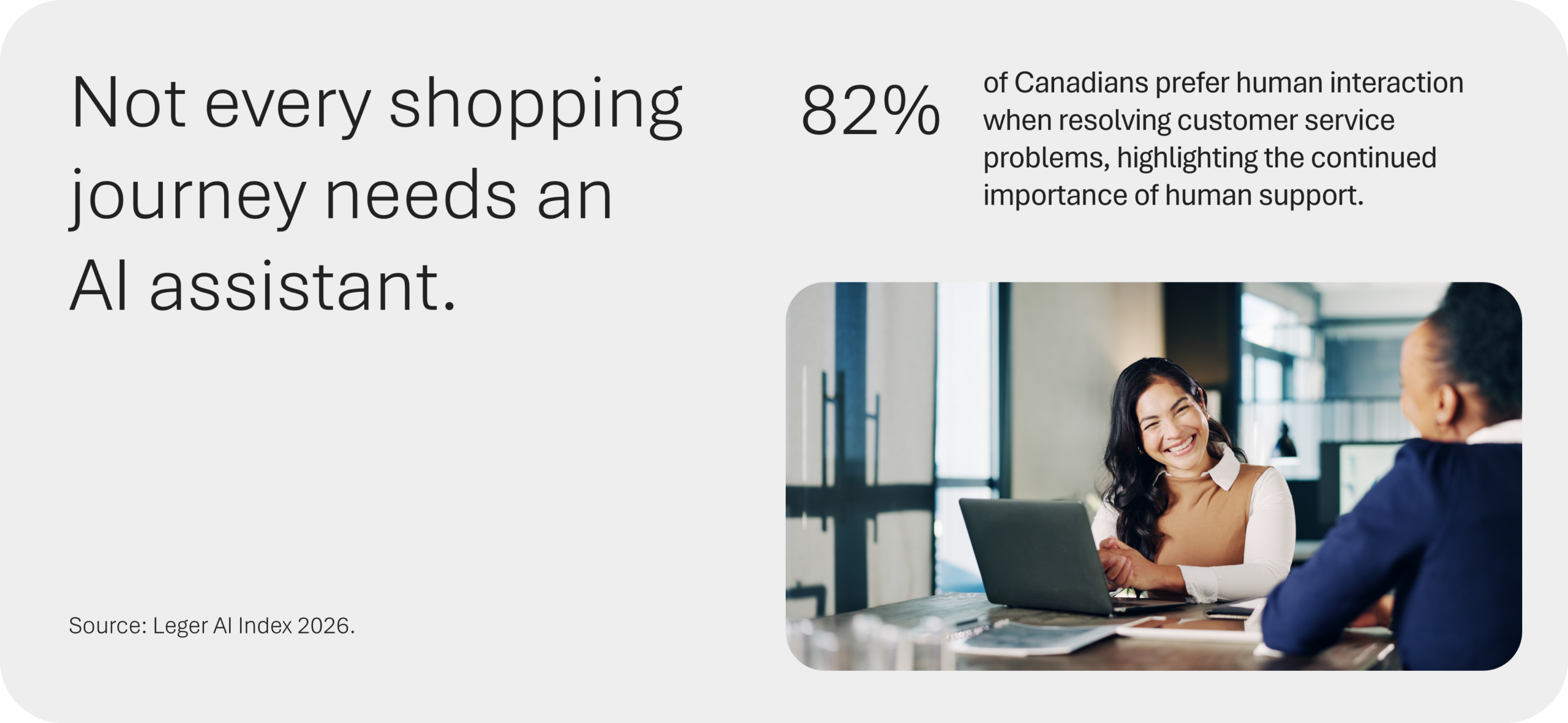
That distinction should shape the retail response. A retailer selling a complex product may benefit from making comparisons and technical guidance easier. A retailer serving routine purchases may have more to gain from improving convenience and availability. And assistance doesn’t always mean automation: 82% of Canadians prefer a human when resolving a customer service problem, according to our AI Index.
The opportunity is to find the moments where AI reduces friction without assuming shoppers want it to handle the entire relationship.
Consumers Are Delegating Research, Not Necessarily Trust
Consumers appreciate the efficiency of AI, but enthusiasm for automated assistance doesn’t necessarily extend to every interaction.
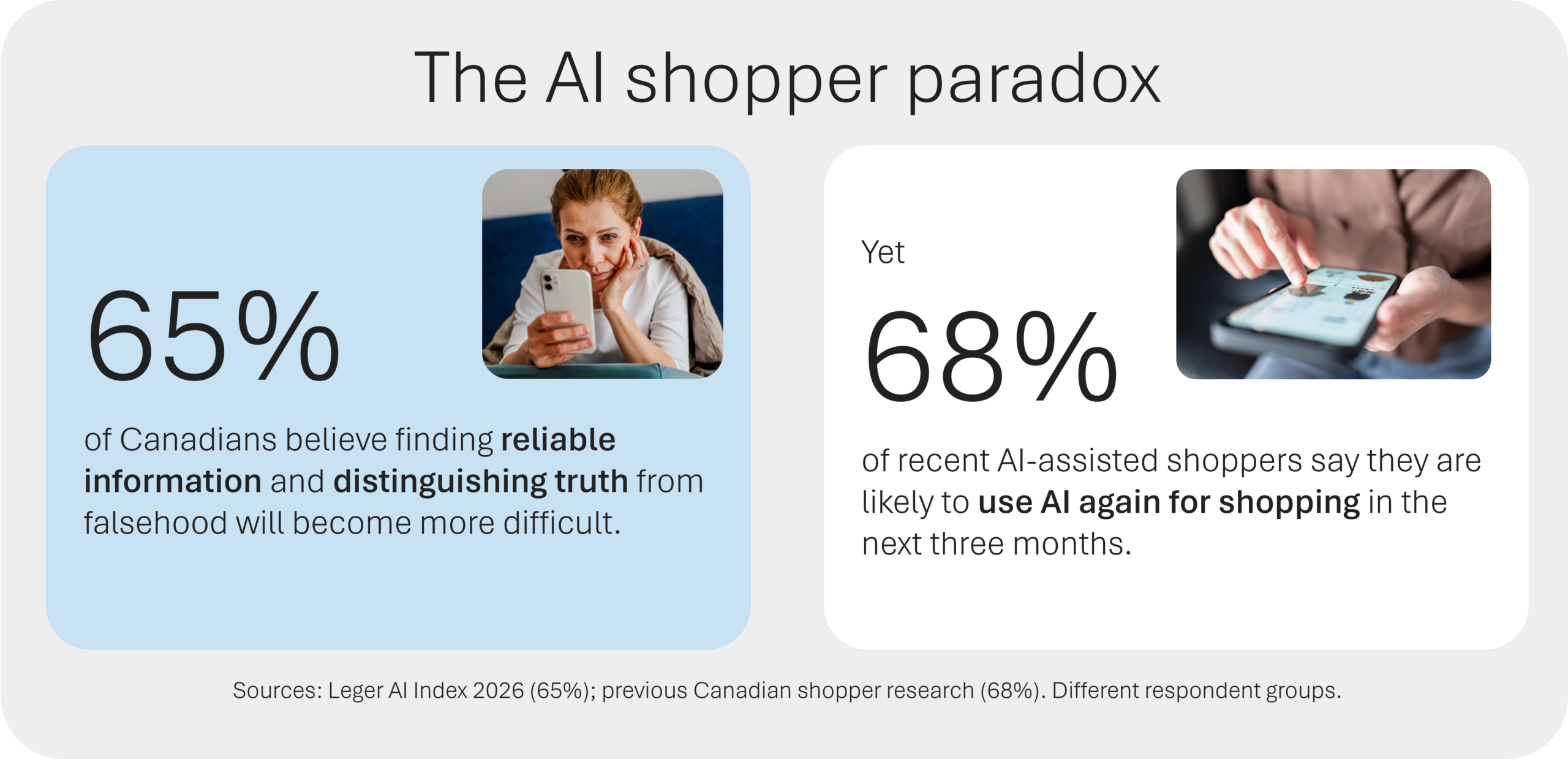
In previous Canadian shopper research, 11% of shoppers said they had used AI for shopping research in the past 30 days. Among those recent users, 68% said they were likely to use it again in the next three months. Yet only 11% of Canadian shoppers expressed high openness to AI shopping assistants. Using AI to answer a shopping question and wanting an AI assistant embedded throughout the journey are not necessarily the same thing.
There is another tension worth understanding. Our AI Index finds that 65% of Canadians believe AI-generated content will make it harder to find reliable information and distinguish what is true from what is false. That concern coexists with repeat-use intentions among recent AI-assisted shoppers. Because these findings come from different respondent groups, they shouldn’t be read as a comparison of attitudes within the same people.
For retailers, trust becomes a design decision. AI can help summarize specifications and compare alternatives; a knowledgeable employee or responsive service team can provide reassurance when the answer is ambiguous, the purchase feels consequential or something goes wrong. The strongest experience may be one that makes the handoff between technology and people feel effortless.
The question isn’t simply where a retailer can automate. It’s where automation helps customers make a confident choice, and where human support preserves that confidence.
How Can Retailers Adapt to AI-Driven Shopping?
The AI shopper revolution doesn’t require every retailer to launch a chatbot tomorrow. It calls for a closer look at how consumers make decisions and how AI could influence those decisions.
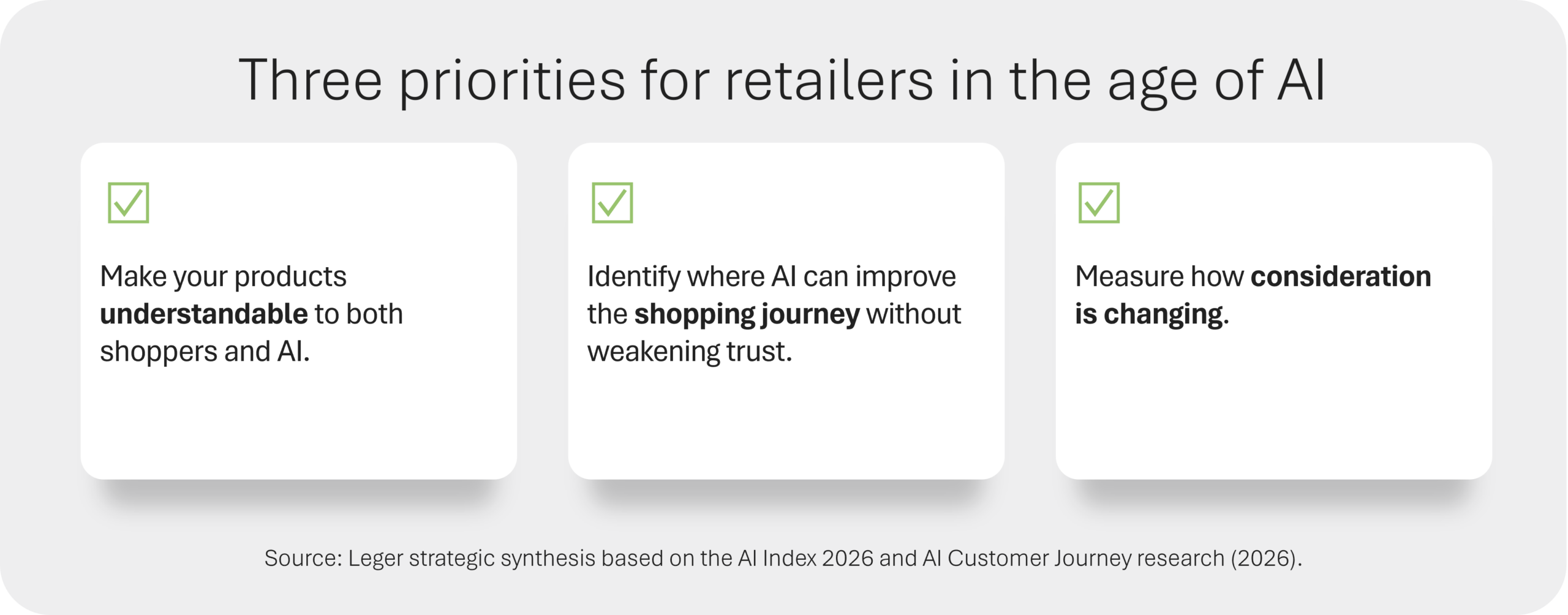
Three priorities stand out:
- Make your products understandable to both shoppers and AI.
Review the quality, consistency and completeness of product information across your digital channels. Think beyond keywords to the questions consumers actually ask, the situations they shop for and the criteria they use to compare alternatives. - Identify where AI can improve the shopping journey without weakening trust.
Explore the category-specific moments when shoppers need guidance, alongside the situations where knowledgeable employees, responsive service and clear accountability remain essential. - Measure how consideration is changing.
Website traffic and conversion rates still matter, but retailers should also investigate whether AI is influencing how consumers discover brands, which alternatives they consider and what ultimately drives their purchase decisions.
The opportunity isn’t simply to become more technologically advanced. It’s to understand how technology is changing the relationship between consumers and brands, and respond in ways that create genuine value.
AI is changing how some shoppers narrow their options, but technology alone won’t determine which retailers earn their business. Product relevance, clarity and confidence still matter. What changes is when, where and how those qualities need to show up.
The retailers best positioned to adapt will be those that know when shoppers want help choosing, what makes a recommendation credible and where human support makes the difference.
Want to explore the research behind the AI Shopper Revolution? Download the presentation for a closer look at how AI is reshaping discovery, comparison and consumer trust, and what these changes mean for retailers.