

Canadians are exposed to food and beverage information from all directions, across media, platforms and everyday interactions. But when it comes to actually trying something new, the in-store environment still has the strongest influence.
Shoppers are open to discovery, especially at the shelf
More than three-quarters of Canadians, 77%, say they are at least somewhat open to trying new food and beverage products, including 21% who actively seek out new options. That openness also shows up in real purchasing behaviour, especially in-store. Nearly half, 47%, say they bought a new-to-them product in-store in the past three months even though they had not planned to, compared with 30% who say the same happened online.
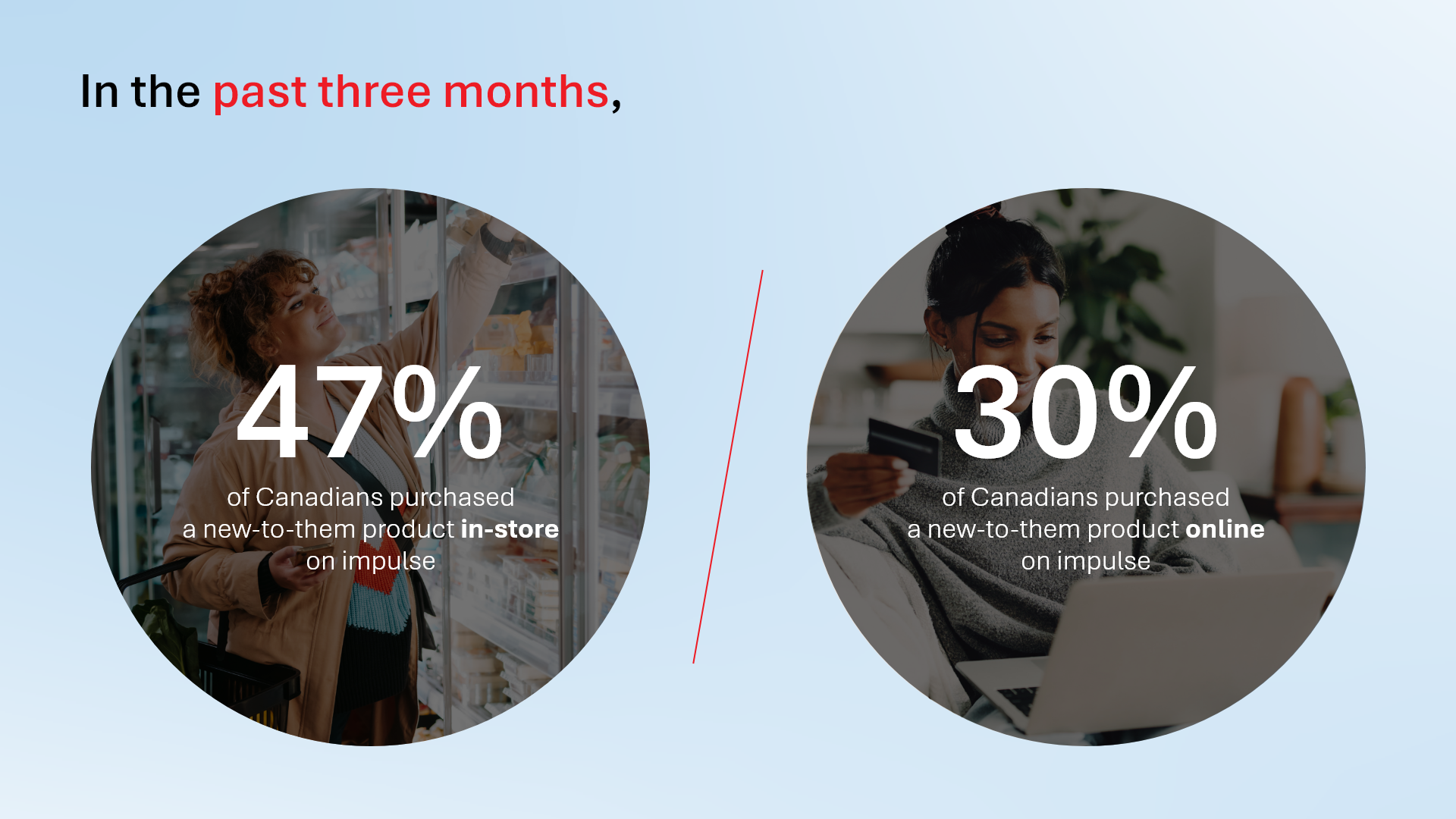
For retailers and manufacturers, that gap says a lot. Digital channels may continue to grow in reach, but the shelf remains one of the most effective places to convert interest into trial.
Trial depends on practical reasons to say yes
Canadians are most likely to try something new when there is a practical reason to do so, whether that is a sample, a deal or clear value for money. The most commonly cited triggers are a sample or tasting at 46%, a promotion such as a discount or coupon at 45%, and value for money at 45%. Just 7% cite advertising as one of the main factors that would encourage them to try a new product.
For brands and retailers, that puts the emphasis squarely on execution in-store. Sampling programs, promotional pricing and clear value communication are not secondary supports. They are central to driving trial.

Discovery happens across channels, but in-store still leads
The same pattern appears in how Canadians discover products. The most common place they notice food and beverage information is in-store, with 32% pointing to products seen on shelves, displays or signage. From there, attention spreads across a range of channels, including Facebook at 31%, television at 30%, and word of mouth through family at 29% and friends or colleagues at 28%. YouTube is mentioned by 27%, while in-store promotions or sampling are cited by 26%.
Generational differences also shape how these channels are used. Among younger Canadians aged 18 to 34, social platforms play a bigger role in discovery, with Instagram reaching roughly three in ten and TikTok about one in five. Older Canadians are more likely to rely on television and flyers, both of which remain important sources of visibility.
Being seen is not the same as shaping the decision
At the same time, visibility does not automatically translate into influence. Canadians may be encountering food and beverage content across many different sources, but only 43% agree that what they saw or heard influenced what they bought in the past three months. Just 6% say it had a strong influence, while a majority, 57%, say it had little or no impact.
That pattern also varies by age. Younger Canadians are more likely to say that food and beverage information shaped their purchases, while older consumers are more likely to report little or no effect.
Trust still sits closest to home and the point of purchase
Reliability was measured among Canadians who said each source had caught their attention in the past three months. Personal relationships came out strongest: 70% rate family as extremely or very reliable, and 61% say the same of friends or colleagues.
Practical shopping sources also perform well, including in-store promotions or sampling at 57%, flyers at 54%, retailer websites or apps at 46%, food or recipe websites or blogs at 44%, and products seen on shelves, displays or signage at 42%. Social platforms trail on trust. Among those who mentioned them, 19% rate Facebook as highly reliable, compared with 26% for Instagram and 28% for TikTok.
Older Canadians are more likely to trust traditional and retail-driven sources such as flyers and in-store cues, while younger Canadians show greater openness to digital sources, even if those still rank behind interpersonal and retail touchpoints overall.
When shoppers seek content, utility comes first
When Canadians actively seek out food and beverage content, usefulness is what leads. A large majority, 81%, engaged with some type of content in the past three months, most commonly recipes or cooking instructions at 46%, promotions or deals at 40%, and health or nutrition information at 32%. Recipe content in particular skews female, with women more likely than men to seek out recipes or cooking instructions.
More exploratory content, such as new products or trends at 21% and reviews or recommendations at 18%, appeals to a smaller audience overall. That suggests product discovery often happens through practical content such as recipes, deals and nutrition information, rather than through trend-driven content alone.
Creator-led content remains a more niche part of the landscape. Just 27% of Canadians say they regularly follow food and beverage creators, accounts or channels. Among that group, Instagram at 45% and YouTube at 43% lead, followed by Facebook at 32% and TikTok at 28%.
This audience can still be influential, particularly among younger consumers, but it does not represent the main path to product discovery or trial.
In-store remains the moment that matters most
Taken together, the results point to a clear pattern. Discovery is broad and fragmented, but trial is more concentrated. The closer a source is to the moment of purchase, and the more practical value it provides, the more likely it is to drive action.
Canadians are not lacking information. They are selective about what earns their attention and what ultimately shapes their behaviour. No single channel dominates, and attention is spread across a wide range of touchpoints. Standing out takes more than reach. It takes relevance and credibility at the point of decision. In-store remains especially powerful because it connects awareness directly to action. It is one of the few environments where discovery and purchase happen side by side.
For retailers and manufacturers, building awareness across channels still matters, but winning at the shelf remains critical. Products that are visible, well supported and easy to try in-store are best positioned to turn openness into actual trial. In crowded categories, the brands most likely to win are the ones that give shoppers a clear reason to say yes in the moment.
For brands, the next step is to move beyond the national average and identify where the opportunity is strongest for their category. That is where deeper analysis becomes especially useful, particularly when it comes to turning these findings into practical guidance for innovation, launch support and retail activation.